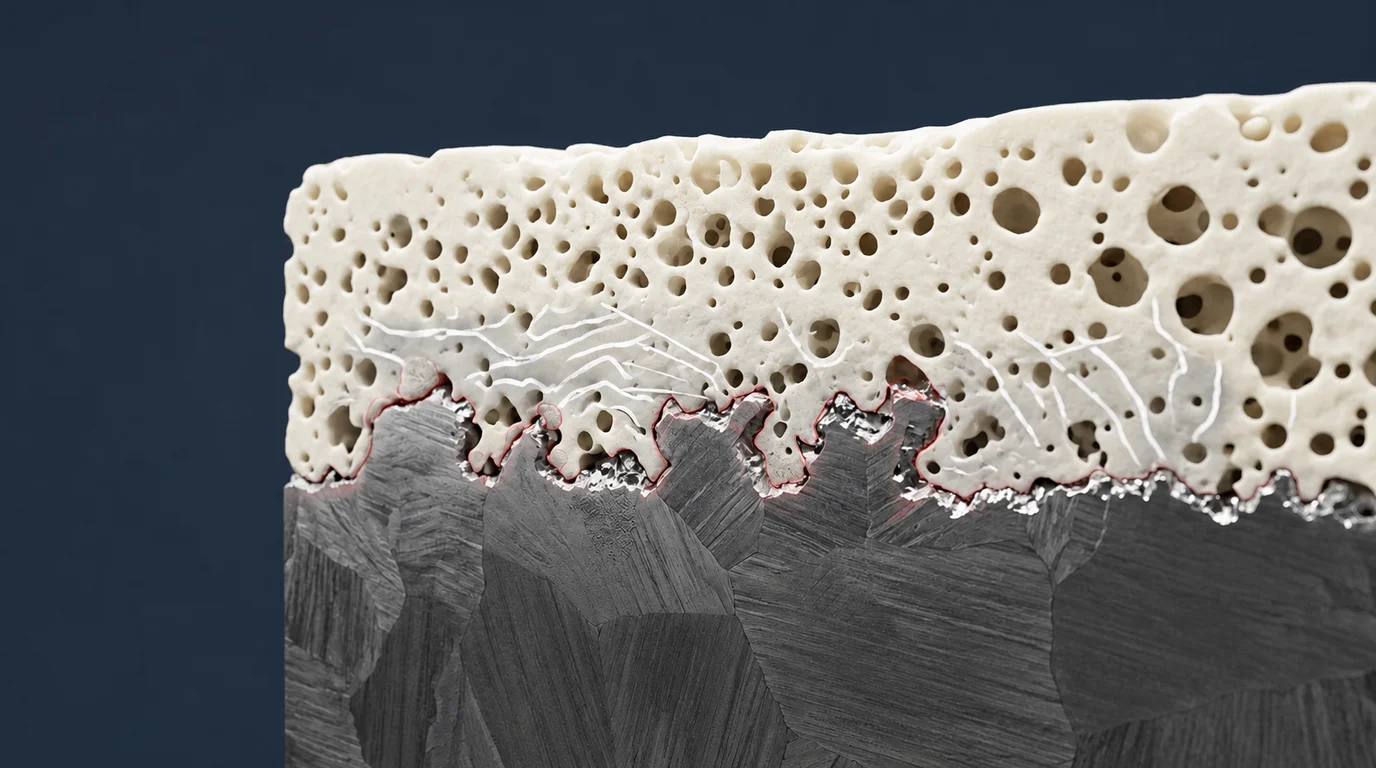
Putting hydroxyapatite (HAp) onto a metal surface does not solve the coating problem by itself.
The metal substrate carries load, while HAp changes the outer material interface. The difficult part sits between them: whether the coating bonds firmly, whether deposition and cooling leave cracks behind, and whether the structure remains intact after contact with a fluid environment.
A 2026 review of HAp coatings on metallic biomaterials identifies stability in physiological fluids, insufficient bonding to the metal substrate, and the intrinsic brittleness of HAp as major limitations. This is not a ranking of coating methods. It is a recurring engineering problem.
Metal Carries Load; HAp Changes the Interface
Titanium alloys, stainless steels, and magnesium alloys can provide structural support. HAp on a metal surface is not intended to replace the metal. It changes the outermost layer that meets the surrounding environment.
The two materials behave differently. Metals can undergo some deformation; HAp is a brittle ceramic. Their different responses to heat, cooling, and loading can make the interface the weak point.
A Rougher Surface Is Not Automatically a Stronger Bond
Grit blasting, laser treatment, and chemical treatment are often used to alter a metal surface and create more opportunities for mechanical interlocking. But the idea that rougher always means stronger is not supported consistently.
A 2025 systematic review included 13 in vitro studies: 4 found that greater roughness improved HAp-coating adhesion, 7 found that other factors also mattered, and 2 reported divergent findings.
Roughness is a starting point. Metal type, surface treatment, coating thickness, and interfacial defects all affect the final bond. The question is not simply whether the surface is rough enough, but whether HAp forms a continuous and stable interface.
Cracks Begin with What Deposition Leaves Behind
HAp coatings are deposited, and some routes involve elevated temperatures or a subsequent heat treatment. This history affects how particles spread and cool, and whether cracks remain inside the coating.
HAp and titanium alloys have different thermal-expansion behavior. During cooling, the coating can experience tensile stress. A surface that appears continuous may still contain microcracks, pores, or weak interlayer regions.
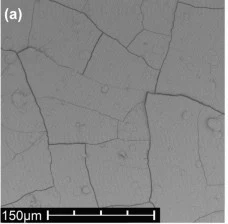
An HAp coating is not paint: a thicker layer is not automatically more stable.
How Can the HAp-Metal Bond Be Improved?
One approach is to introduce an intermediate layer between the metal and HAp, such as TiO2. A 2022 sol-gel study found many microcracks in HAp deposited directly on Ti6Al4V. With TiO2 intermediate layers, coating integrity and adhesion improved.
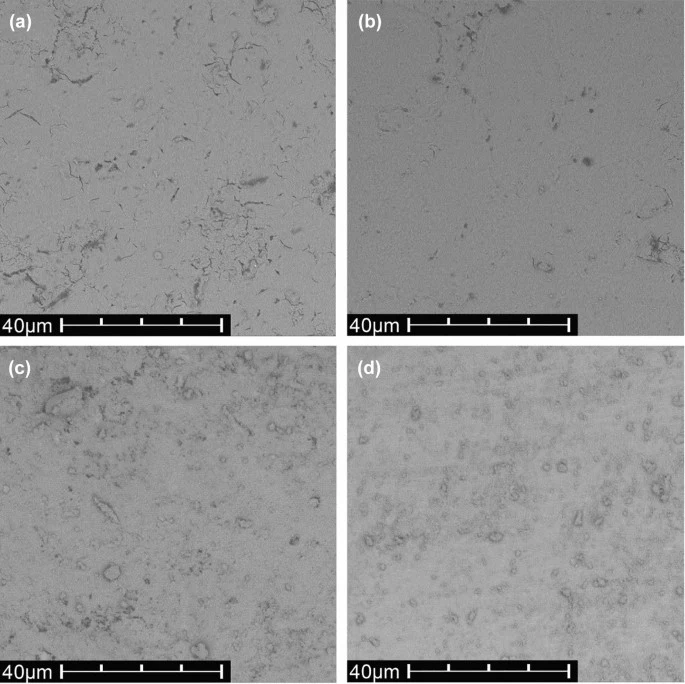
An intermediate layer does more than add material. It may reduce the mismatch across the interface and change the wetting and interlocking conditions at the surface.
Another approach is to introduce additional phases into HAp to improve density and crack resistance. In one 2025 plasma-spray study, an HA-Ti-MgO composite coating reached 29.2 ± 3.4 MPa in adhesion strength, compared with 6.9 ± 0.6 MPa for the pure HAp coating. Those numbers belong to one powder system, substrate treatment, and spray condition. Even with the same formulation, a different powder state, substrate treatment, or spray parameter can produce a different coating.
The Coating Continues to Change in a Fluid Environment
Bond strength measured in a dry state only describes the starting point. Once a coating meets a fluid environment, liquid can enter through pores or microcracks. Local dissolution, ion exchange, reprecipitation, interfacial corrosion, or new damage under load may follow.
| What to examine | Question to answer |
|---|---|
| Interface and cross-section | Is the coating continuous, or are pores, cracks, or local delamination present? |
| Material state after deposition | Did HAp change substantially after spraying or heat treatment? |
| Bonding and immersion results | How strong is the initial bond, and does it remain after simulated-fluid exposure without new corrosion or damage? |
One adhesion number cannot represent long-term stability. A surface image cannot rule out weak regions inside the coating.
What This Evidence Can Show
The available evidence comes mainly from materials studies, immersion tests, electrochemical testing, and literature reviews. It can help explain why a coating may crack, delaminate, or change at the interface. It does not directly establish clinical safety, implant lifetime, or long-term bone integration for a particular coating.
For an HAp coating, surface coverage is only the beginning. What matters is how the coating bonds to the metal, what weak regions remain after processing, and whether those regions continue to change in a fluid environment.
This article is a public literature interpretation. It discusses material and interface stability in HAp coatings on metals. It does not provide medical-product recommendations, clinical indications, or treatment advice.
References
- Amin M, Pusparizkita YM, Schmahl WW, et al. Novel advances and approaches in hydroxyapatite-based coating on metallic biomaterials. Journal of Alloys and Compounds Communications. 2026;10:100187. DOI: 10.1016/j.jacomc.2026.100187.
- de Melo-Soares V, Gazott-Simões I, dos Reis AC, Valente MLC. Influence of Surface Roughness on the Adhesion of Hydroxyapatite Coatings to Titanium and Titanium Alloy Surfaces: A Systematic Review of in vitro Experimental Studies. European Journal of Prosthodontics and Restorative Dentistry. 2025;33(1):93-103. DOI: 10.1922/EJPRD_2776Melo-Soares11.
- Jaafar A, Schimpf C, Mandel M, et al. Sol-gel derived hydroxyapatite coating on titanium implants: Optimization of sol-gel process and engineering the interface. Journal of Materials Research. 2022;37:2558-2570. DOI: 10.1557/s43578-022-00550-0.
- Nadian N, Nourouzi S, Jamshidi Aval H. Innovative plasma spray coating of HA-Ti-MgO composite on Ti6Al4V alloy for enhanced performance. Journal of Materials Science: Materials in Medicine. 2025;36:63. DOI: 10.1007/s10856-025-06920-4.