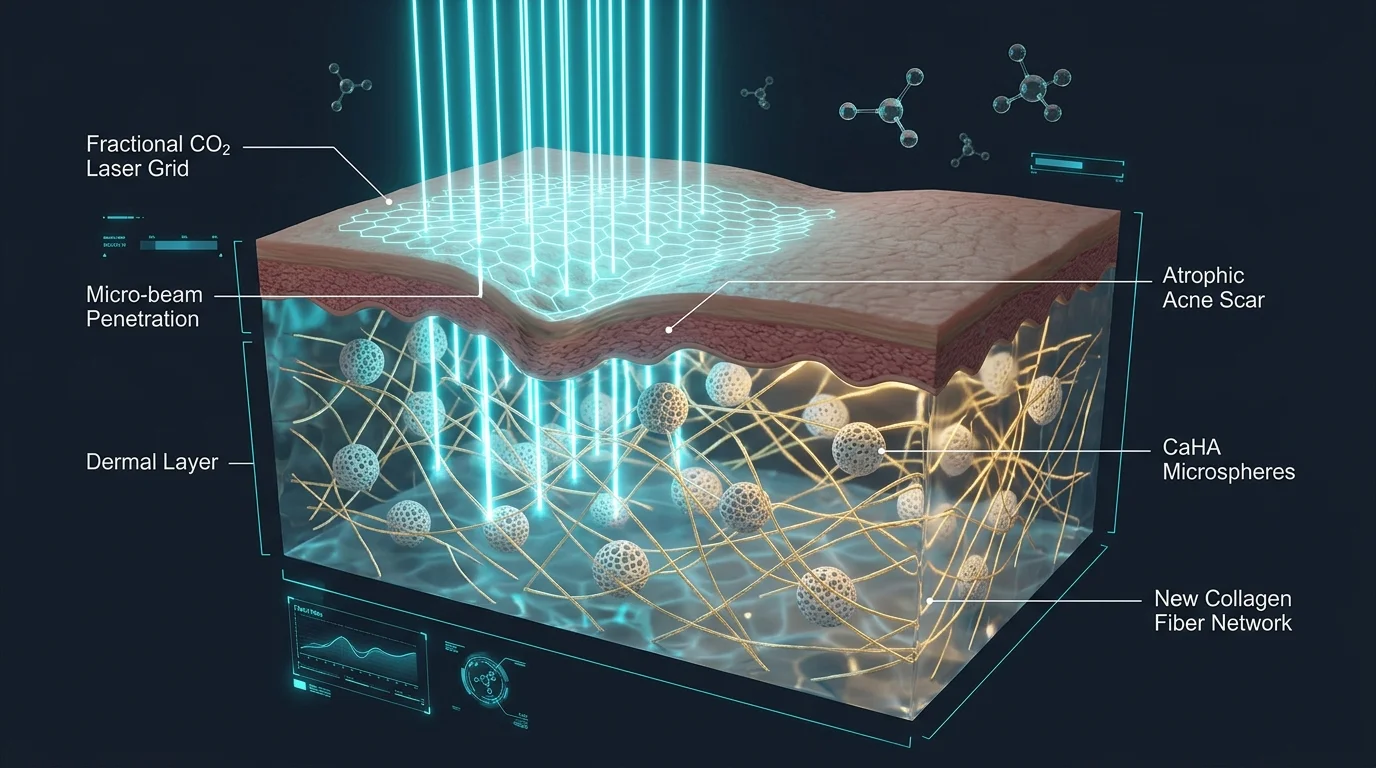
In July 2026, Aesthetic Plastic Surgery published a prospective, single-center randomized controlled clinical study. The journal assigns it Level II evidence. It compared fractional CO2 laser alone with a combined approach in which a CaHA suspension prepared with non-crosslinked hyaluronic acid (HA) was added after the laser treatment.
One hundred sixty people with facial atrophic acne scars were enrolled, and 159 completed the six-month observation period. The paper recorded scar scores, blinded photographic assessments, participant satisfaction, and adverse events. It was not a comparison of CaHA products, and it did not evaluate CaHA on its own.
What Did the Trial Compare?
| Group | Protocol | Primary follow-up |
|---|---|---|
| Control | One fractional CO2 laser treatment only | Six months after the laser |
| Combination | Fractional CO2 laser, followed one month later by the first of two CaHA–HA injections; the injections were one month apart | Six months after the laser |
The groups differed by more than the presence of CaHA. The combination group also received two injections and an HA carrier; the control group had neither sham injections nor an HA-only comparator. The trial can therefore report a difference between this defined combination and laser alone, but it cannot attribute the entire difference to CaHA microspheres.
Scar Scores Changed More in the Combination Group
At six months, quantitative global scarring scores had fallen from baseline in both groups. The mean change was larger in the combination group: 10.61 ± 7.50 points, versus 5.74 ± 2.97 points with laser alone. Blinded global-assessment scores and participant satisfaction pointed in the same direction.
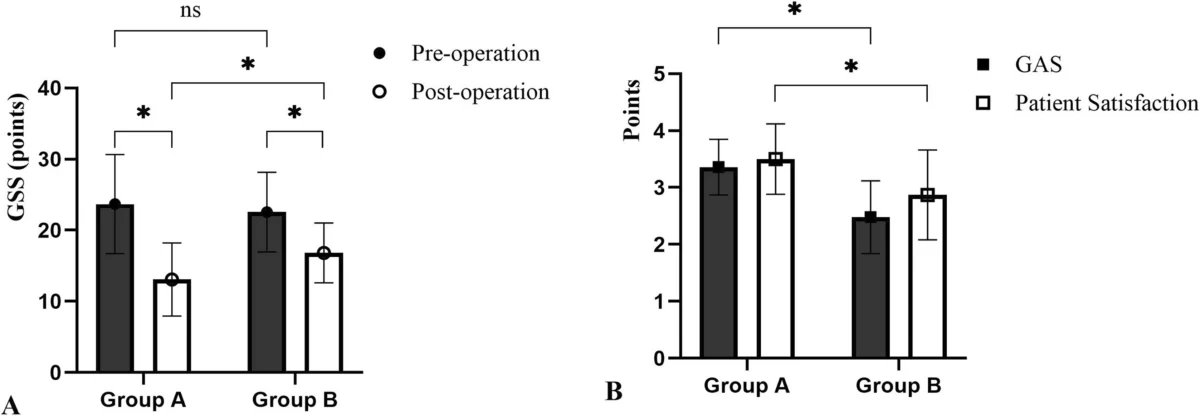
| Measure | Combination group | Laser-only group |
|---|---|---|
| Mean change in global scarring score | 10.61 ± 7.50 points | 5.74 ± 2.97 points |
| Blinded global-assessment score | 3.36 ± 0.49 | 2.48 ± 0.64 |
| Participant-satisfaction score | 3.50 ± 0.62 | 2.87 ± 0.79 |
The paper also examined icepick, boxcar, and rolling scars within the combination group. All three showed score improvements. Boxcar and rolling scars did not differ significantly from each other and both showed larger improvement than icepick scars. That comparison was made within the combination group; it does not identify a preferred regimen for each scar type.
The Study Used a Prepared CaHA–HA Suspension
The material description is more specific than simply saying that CaHA was used. The investigators prepared a 5 mL suspension from 50 mg of lyophilized CaHA powder with sterile saline, 2% lidocaine hydrochloride, and 10 mg/mL non-crosslinked HA gel. The reported CaHA microspheres were 25–40 μm in diameter and had porosity above 60%.
The authors used non-crosslinked HA as a short-term dispersing and delivery vehicle, while also acknowledging that they could not separate short-term effects of CaHA from those of HA. This was a defined, on-site prepared suspension from a stated source; it does not stand in for material or clinical evidence on other CaHA microspheres or finished formulations.
Recovery Timing and Injection-Related Events Need to Be Read Together
Both groups recorded pain, edema, crusting, and transient post-inflammatory erythema after the laser procedure. In the combination group, long-term post-inflammatory erythema and hyperpigmentation resolved sooner by averages of about 3.8 and 3.7 weeks, respectively. Their incidence did not differ significantly between groups.
Twenty-eight people in the combination group, or 35.0%, had post-injection ecchymosis, which resolved without intervention in one to two weeks. No persistent nodules, granulomas, tissue overgrowth, or chronic inflammation were reported during the six-month observation period. These data describe the common events observed in the study but are insufficient to assess rare complications or longer-term safety.
What Can This Study Establish?
The paper reports differences between laser alone and one defined combination under single-center conditions over six months. One value of the study is that it clearly documents the microsphere characteristics, carrier composition, and treatment sequence.
It does not establish that every CaHA product, laser setting, or atrophic acne scar will produce the same result. Nor should findings from the combination be described as a standalone CaHA effect. Material composition, carrier, study sequence, and control design all matter when comparing this literature.
This article interprets one published study of a defined CaHA–HA suspension combined with fractional CO2 laser. It does not provide medical-product recommendations, clinical indications, or treatment advice.
References
- Chen W, Zhang L, Luo X, et al. Calcium Hydroxylapatite Combined with CO2 Ablative Fractional Laser for Atrophic Acne Scars: A Randomized Controlled Study. Aesthetic Plastic Surgery. Published online July 6, 2026. DOI: 10.1007/s00266-026-06142-1.