
In 2026, the Journal of Cosmetic Dermatology published a study of CaHA treatment for temporal contour restoration.
The study enrolled 36 Chinese women: 24 received CaHA treatment and 12 received no treatment as comparators. The researchers followed them at 1, 6, and 12 months and used three-dimensional facial scans to record changes in temporal contour and volume.
The paper examined one defined CaHA-CMC finished-product system. Its findings do not replace material characterization for CaHA microspheres or research on other products.
Its core question was straightforward: after CaHA treatment, how long can temporal contour improvement last?
At 12 Months, Contour Improvement Was Still Present
Participants who received treatment showed improvement in temporal hollowing and overall appearance assessments. Three-dimensional scans also recorded increased temporal volume, with little change between months 6 and 12.
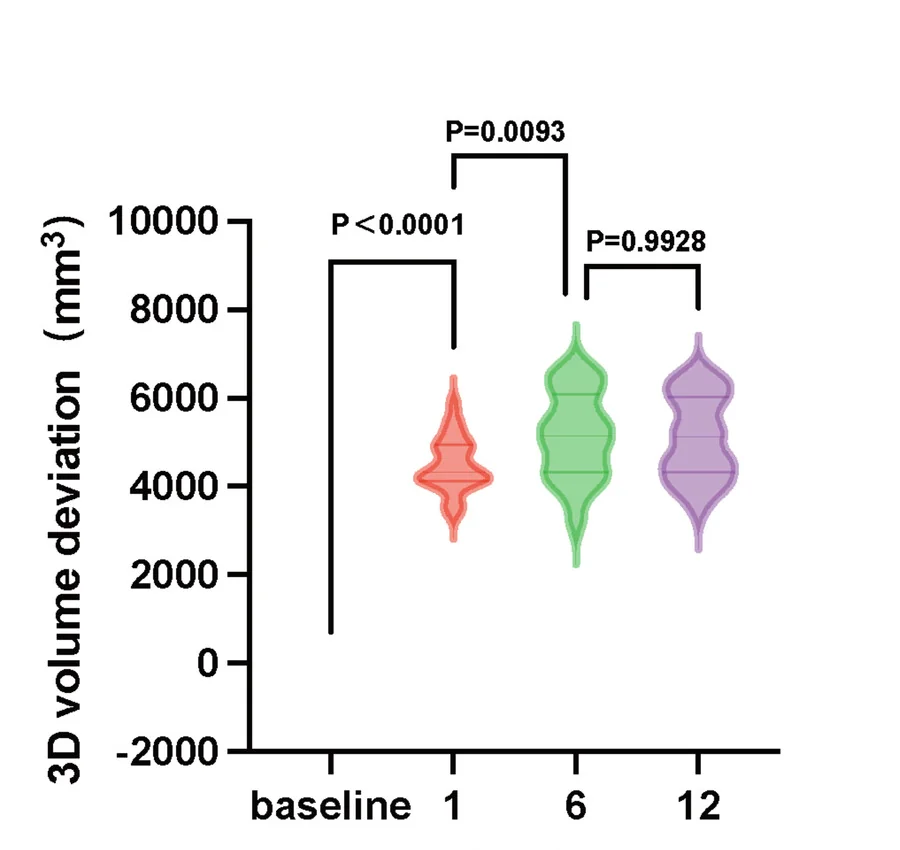
Under the complete study plan, temporal contour improvement was recorded through 12 months.
One condition matters. Of the 24 treated participants, only 4 completed one session; the other 20 received a supplementary session at month 1. The study does not show that one session naturally lasts a year. It shows 12-month follow-up under a plan that allowed a month-one adjustment.
What Did 3D Scanning Add Beyond Photographs?
Before-and-after photographs can be affected by angle, lighting, and facial expression. Three-dimensional scans compare the facial surface at different time points and help record changes in temporal volume and contour.
The paper also described outward and slightly upward local movement after temporal treatment, with some changes around the brow tail, eye area, and other facial contours.
That is not proof that temporal treatment lifts the whole face. The related analysis was exploratory and involved only a small number of participants. More research is needed to establish its meaning.
Does Stable Volume Mean More Collagen?
CaHA is often discussed in relation to collagen formation. In this study, temporal volume remained relatively stable later in follow-up. The authors linked that pattern to material support and subsequent tissue response.
Three-dimensional scans measure external contour and volume. They do not directly show collagen or quantify how much collagen has formed. The study did not include tissue biopsy, so its findings should not be described as proof that 3D scanning demonstrated collagen formation.
What Was Recorded About Safety?
The study recorded local swelling, pain, tenderness, and redness, most of which resolved in the short term. A small number of participants later reported intermittent periorbital edema that gradually resolved after management.
No serious adverse events were reported. However, only 24 participants received treatment. That sample can record common reactions, but it cannot assess rare serious risks.
How Should This Result Be Read?
The study provides 12-month follow-up data from Chinese women and shows how three-dimensional scanning can be used to assess facial contour.
When reading similar studies, duration is only one part of the picture. It also matters whether supplementary treatment was allowed, whether the result comes from photographs or three-dimensional measurement, whether volume change is being mistaken for collagen formation, and whether the sample is large enough to discuss safety.
For this study, the appropriate conclusion is narrow: under a plan that allowed a supplementary session at month 1, temporal contour improvement after CaHA treatment was followed through 12 months. It does not represent every CaHA product or directly prove a whole-face lifting effect or increased collagen.
This article is a public literature note. It discusses the design and findings of one study of CaHA treatment for temporal contour restoration. It does not provide medical-product recommendations, clinical indications, or treatment advice.
References
- Zhu D, Chen J, Wei W, et al. Clinical and Three-Dimensional Evaluation of Calcium Hydroxylapatite for Temporal Contour Restoration in a Chinese Population. Journal of Cosmetic Dermatology. 2026;25(7):e71026. DOI: 10.1111/jocd.71026.