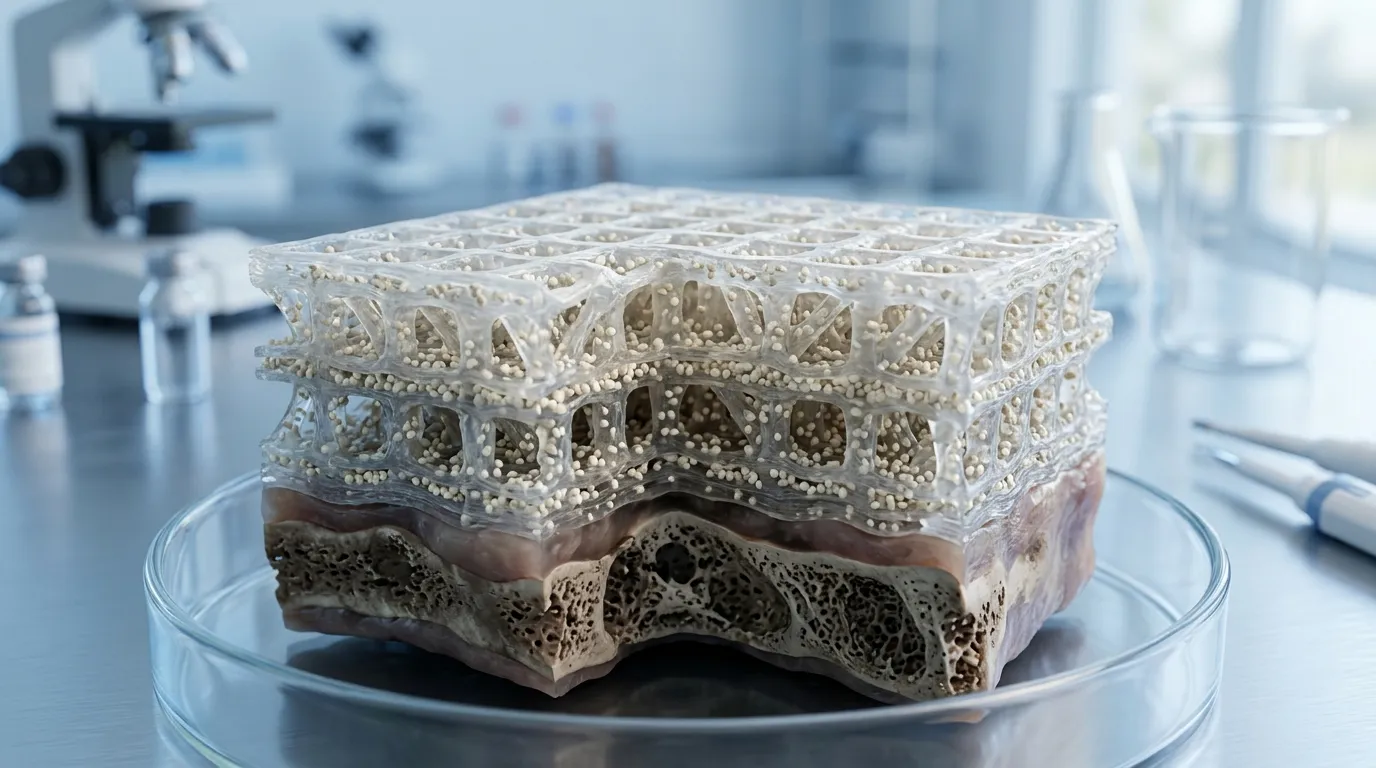
In July 2026, ACS Biomaterials Science & Engineering published a study of a 3D-printed resorbable membrane for maxillofacial bone regeneration. The researchers combined gelatin methacrylate (GelMA), alginate, and hydroxyapatite (HAp) in one composite system.
The point is not HAp alone. The study examines a membrane design that brings barrier function, wet-state support, degradation behavior, and a mineral phase into the same material system.
Maintaining Space Is the First Requirement
Guided bone regeneration (GBR) uses a barrier membrane over a bone defect to limit early soft-tissue ingrowth and preserve a space for bone-related cell migration and new bone formation.
A GBR membrane generally needs to meet several requirements at once:
- Provide a stable physical barrier;
- Retain its shape and integrity in wet conditions;
- Allow nutrient and metabolite exchange;
- Degrade over an appropriate time frame;
- Neither disappear substantially before bone repair progresses nor remain indefinitely.
Resorbable membranes can avoid a second removal procedure, but excessive softness, inadequate wet-state support, or unsuitable degradation behavior can limit practical performance. Composite formulations and structural design are being explored to manage those trade-offs.
What Do GelMA and Alginate Contribute?
GelMA is a photocrosslinkable material derived from modified gelatin. It retains structures associated with cell adhesion and enzymatic degradation, while crosslinking conditions can be used to tune hydrogel mechanics and degradation. It is therefore widely used in tissue-engineering and 3D-printing research.
On its own, GelMA can still be limited by structural stability, wet-state strength, and its printable processing window.
Alginate has useful gel-forming properties and can help a material retain its structure during printing and shaping. Together, GelMA and alginate offer a way to tune printability, structural stability, and the local material environment.
These systems remain predominantly polymeric hydrogels, however, and do not reproduce the inorganic mineral environment of natural bone. HAp is added to introduce that mineral phase.
HAp Is Not Simply a Filler
Hydroxyapatite (HAp) is a major inorganic component of bone. In bone-repair materials, it is used to introduce a surface and local environment closer to mineralized tissue, rather than simply to make a material harder.
Within a GelMA/alginate system, HAp introduces an inorganic mineral phase into the polymer network. It may also affect surface roughness, water uptake, mechanical behavior, and degradation.
There is no fixed direction for these changes. HAp loading, particle state, dispersion, and interfacial interaction with the polymer network all influence the result. Uneven dispersion can also lead to local agglomeration, printing instability, or mechanical variation. Evaluation therefore needs to consider how particles enter the formulation and whether the original balance between shaping and degradation is retained.
Why 3D Print the Membrane?
Conventional membranes are typically made with fixed thicknesses and pore structures, making it difficult to adapt their internal architecture to a specific bone defect.
3D printing can control membrane thickness, porosity, and overall geometry through print paths, layer spacing, and formulation. For irregular maxillofacial defects, it also creates a route toward geometry-specific designs.
Printability alone does not establish readiness for further validation. The printed composite membrane still needs to be assessed for:
- Structural retention in wet conditions;
- Whether porosity weakens the barrier function;
- Uniform HAp dispersion;
- Retention of space as the material degrades;
- Changes caused by sterilization and storage;
- Whether cell-study observations are confirmed in subsequent animal or clinical research.
These questions determine whether the system merits the next stage of material and product validation, rather than remaining a laboratory print sample.
What Does the Study Establish?
The paper does not propose that one material can directly replace existing GBR membranes. It presents a composite-design approach: GelMA provides a polymer environment resembling the extracellular matrix, alginate supports gelation and shaping, HAp supplies an inorganic phase associated with bone mineral, and 3D printing controls the membrane architecture. Together, these components address barrier function, degradation, shaping, and the bone-tissue interface.
Material characterization and cell studies can support the next stage of material evaluation, but they cannot predict bone-regeneration outcomes in people. Long-term stability, degradation matching, in vivo response, sterilization compatibility, and manufacturing reproducibility still require further work.
For HAp composite design, the study points to a simple rule: particle properties, dispersion in the hydrogel, the polymer-particle interface, and the final macrostructure need to be evaluated as one system.
This article interprets published literature on HAp composite GBR membrane design. It does not provide medical product recommendations, clinical indications, or treatment advice.
References
- Anupan W, Thuaksuban N, Sangkert S, et al. Biomimetic 3D-Printed Resorbable Extracellular Matrix-Guided Bone Regeneration Membrane Based on a Gelatin Methacrylate/Alginate-Hydroxyapatite Composite for Maxillofacial Surgery. ACS Biomaterials Science & Engineering. Published online July 2, 2026. DOI: 10.1021/acsbiomaterials.6c00311.