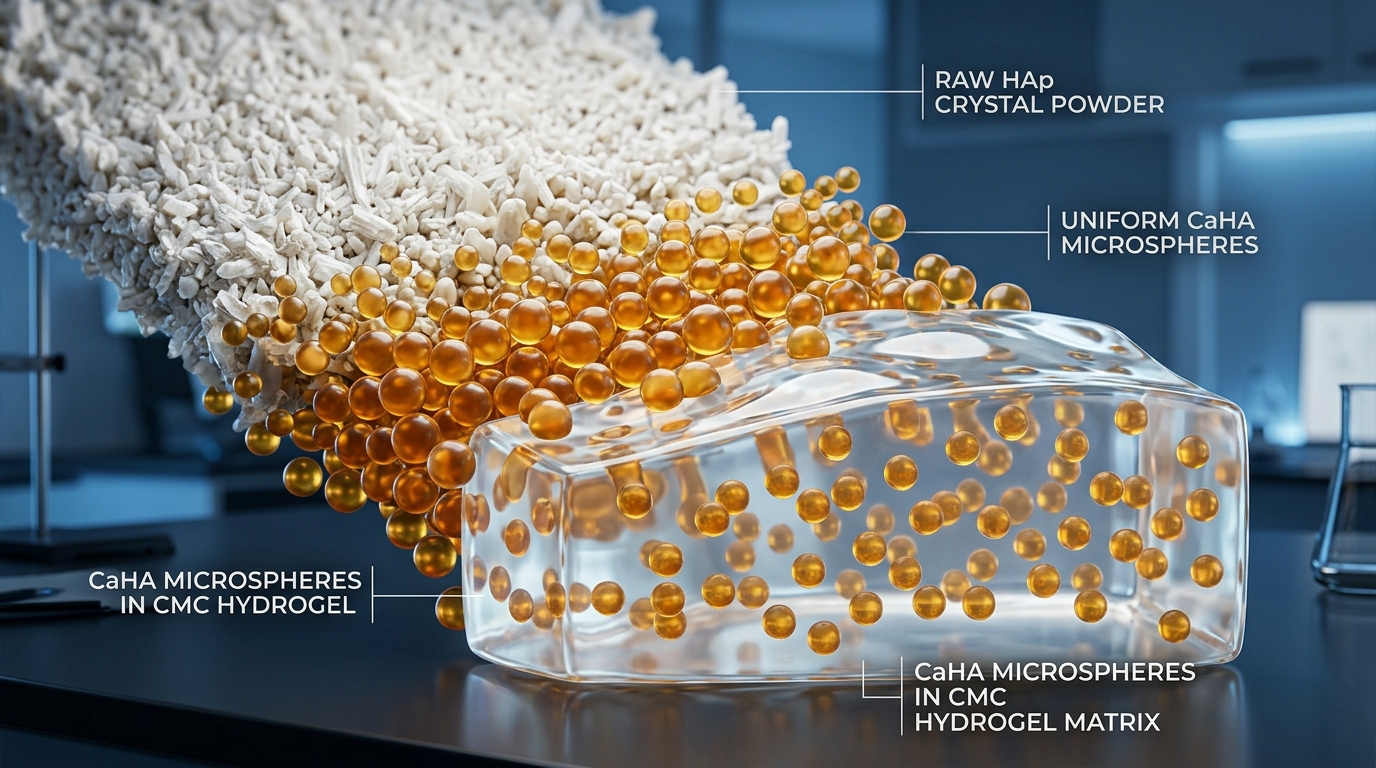
Searches for CaHA often return several similar descriptions: CaHA powder, CaHA microspheres, 25–45 μm CaHA particles, and CaHA-CMC injectable systems.
All may contain calcium hydroxylapatite as the inorganic phase, but they do not describe the same material level. Powder is a starting material. A microsphere is a formed particle produced by granulation or another shaping process and may undergo further heat treatment. A finished injectable system adds a carrier, particle concentration, dispersion state, and rheological behavior.
Without that distinction, powder-size data may be used to describe microsphere diameter, one microsphere SEM image may be used to infer formulation performance, or a clinical study of a finished product may be attributed to CaHA powder itself.
CaHA Powder Describes the Starting Material
For CaHA powder, the first questions concern composition, crystalline phase, particle-population state, and impurity control. Typical records include X-ray diffraction (XRD), Ca/P, particle-size distribution, SEM morphology, purity, and trace-element results appropriate to the intended use.
D10, D50, and D90 are among the most frequently misread values. D50 is the equivalent particle size at which the cumulative distribution reaches 50%, under a stated analytical method and distribution basis. Laser-diffraction results also depend on the dispersion medium, sonication conditions, agglomeration state, and whether the distribution is expressed by volume or number. A D50 value should not be compared without its method context.
Most importantly, powder D50 describes the powder under defined test conditions. It does not state the diameter of microspheres that may later be made from that powder.
For illustration only, a powder with a D50 of 10 μm could later be granulated, spray dried, shaped, or sintered into larger secondary particles or microspheres. Powder particle size and microsphere diameter refer to different populations and do not need to match numerically.
Microspheres Add a Formed Structure
A CaHA microsphere is not simply powder under another name. Finer CaHA particles are assembled through a defined process into a formed particle with an external contour and an internal structure.
A 2008 study of spray-dried HAp microspheres showed that increasing sintering temperature promoted crystal growth and particle bonding while changing specific surface area, pore volume, dispersibility, and surface morphology. Those findings belong to one spray-drying and sintering system and should not be generalized to every microsphere process. They do demonstrate that forming and heat treatment can redefine particle state.
At the microsphere level, diameter distribution, sphericity, fragments and outliers, surface structure, pore or dense structure, and integrity after processing require separate evaluation. A diameter distribution should also state the sampling method, number of particles, image-analysis method, and statistical basis rather than report only a minimum and maximum.
Powder SEM examines primary particles or agglomerates. Microsphere SEM examines the contour and surface of formed particles. Because the samples have different identities, a powder image cannot replace representative microsphere analysis.
A Finished Injectable System Adds New Variables
In a CaHA-CMC injectable system, CaHA particles are only one part of the formulation. The FDA Summary of Safety and Effectiveness Data for RADIESSE describes that specific finished product as synthetic CaHA particles suspended in a gel carrier of sterile water for injection, glycerin, and sodium carboxymethylcellulose. The document states a CaHA particle-size range of 25–45 μm.
That range is a product-specific public description, not a universal specification for injectable CaHA microspheres. At this stage, the evaluation object is the complete combination of particles, carrier, particle concentration, and dispersion state.
The same FDA document reports bench testing of the final packaged and sterilized product, including injection testing, syringe leakage, simulated use, and particle durability. A 2023 PMA supplement, P050052/S153, separately records implementation of a new CaHA-particle sieve system used in the manufacture of COAPTITE, RADIESSE, and RADIESSE (+). Together, these records show that particle control matters, but particles alone are not the finished formulation.
What Evidence Belongs to Each Level?
| Material level | Typical evidence | Main question answered | What it cannot establish directly |
|---|---|---|---|
| CaHA powder | XRD, chemical analysis, particle-size analysis, SEM | Phase, Ca/P, powder-size distribution, and morphology | Microsphere diameter, sphericity, or formulation performance |
| CaHA microspheres | Image statistics, SEM, density or porosity assessment, integrity testing | Microsphere size, morphology, surface, and internal structure | Rheology, injectability, or tissue response of a finished system |
| Finished CaHA system | Formulation analysis, rheology, dispersion stability, injectability, sterilization, and use-specific evaluation | The state of particles and carrier as a complete formulation | Every quality attribute of the starting powder |
Particle size is the clearest example. A hypothetical powder D50 of 10 μm describes a cumulative powder distribution. A 25–45 μm range may describe a formed-particle specification. The values belong to different populations and cannot substitute for one another.
SEM has the same limitation. Powder SEM, microsphere SEM, and SEM performed after particles have been isolated from a gel involve different samples and preparation steps. Our review of SEM methodology for CaHA microspheres discusses the interpretation limits of isolating particles from commercial injectable systems.
High-Purity CaHA Does Not Make Finished Products Equivalent
Phase and chemical composition are foundational, but they do not capture variables introduced during forming and formulation. Two powders may both contain HAp/CaHA as the principal crystalline phase and have Ca/P values near the target range, yet form microspheres with different diameters, surfaces, or pore structures.
Likewise, even CaHA microspheres with similar particle characteristics may behave differently when the carrier, particle concentration, mixing, or sterilization conditions change. A recent in vitro comparison of two commercial CaHA injectable systems also showed why the same manufacturer-reported particle range does not establish complete material equivalence. See our review of reported CaHA particle ranges and in vitro response.
The reverse inference is equally weak. Clinical findings for one CaHA-CMC product do not establish the same performance for other CaHA materials with a similar Ca/P ratio or powder size. A clinical study evaluates a specific product, formulation, manufacturing process, and conditions of use, not a chemical name alone.
Technical Files Should Stay at the Correct Level
When the supplied form is CaHA powder, the documentation should first describe that powder accurately: the method and distribution basis used for particle size, the definitions of D10/D50/D90, the basis used for Ca/P, the evidence supporting the phase assignment, and whether SEM shows individual particles or agglomerates.
If the powder is then made into microspheres, the formed particles need a new set of size, morphology, and structural data. If those microspheres are incorporated into CaHA-CMC or another composite system, the finished formulation requires its own rheology, dispersion, stability, and use-specific performance assessment.
CaHA powder, formed particles, and finished formulations are different material identities under the same chemical name. Once the material level is clear, particle size, SEM, XRD, rheology, and biological results have the correct object of interpretation.
This article explains the technical distinctions among physical forms and material levels of CaHA. It does not extrapolate powder or microsphere properties to the clinical performance of a specific medical product and does not provide product-use guidance.
References
- U.S. Food and Drug Administration. Summary of Safety and Effectiveness Data: RADIESSE Injectable Implant, PMA P050052. FDA public document.
- Wang AJ, Lu YP, Zhu RF, et al. Effect of sintering on porosity, phase, and surface morphology of spray dried hydroxyapatite microspheres. Journal of Biomedical Materials Research Part A. 2008;87(2):557–562. DOI: 10.1002/jbm.a.31895.
- Sanchez Rico GA, Andrade Canto SB. Three Calcium Hydroxylapatite-Based Dermal Fillers Marketed in Mexico: Comparison of Particle Size and Shape Using Electron Microscopy. Journal of Cosmetic Dermatology. 2025;24(3):e70100. DOI: 10.1111/jocd.70100.
- U.S. Food and Drug Administration. RADIESSE PMA Supplement P050052/S153: Implementation of a New Sieve System of CaHA Particles. FDA PMA database.