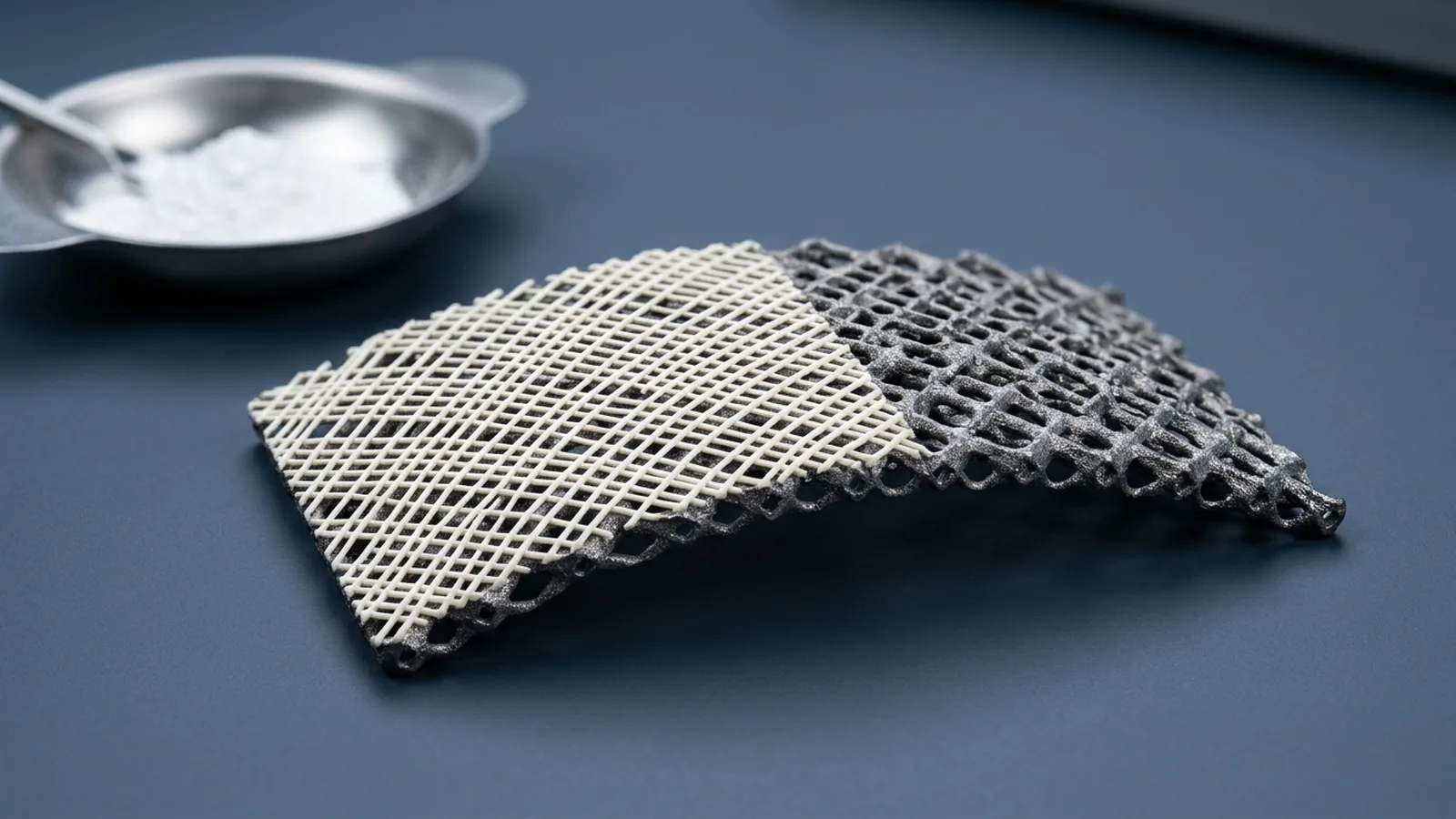
Surface modification of titanium implants requires attention to the mineral phase, organic components and deposited architecture. Combining hydroxyapatite with collagen creates a material system that reflects the mineral–organic composition of bone, while its in vitro behavior must be assessed for the specific fabrication process.
A study by Lazăr and colleagues in volume 70, issue 2 of the Romanian Journal of Ophthalmology (2026) investigated hydroxyapatite–collagen composites on 3D-printed titanium mesh designed for orbital fracture repair. The authors compared extracts from spray-coated and direct-ink-written specimens using osteoblasts. The evidence consists of material preparation and in vitro cell testing.
From composite powder to a three-layer structure
The starting materials were calcium nitrate, ammonium dihydrogen phosphate and hydrolyzed collagen. Ammonia was used to establish alkaline conditions before hydrothermal treatment at 100 °C. Filtration, washing and spray drying produced a composite powder with a HAp-to-collagen mass ratio of 4:1.
Elemental analysis, Fourier-transform infrared spectroscopy (FTIR), X-ray diffraction (XRD) and scanning electron microscopy with energy-dispersive spectroscopy (SEM-EDS) were used to examine composition, functional groups, phases and morphology. Surface processing involved spray deposition or robocasting, with the printed specimens carrying three HAp–collagen layers on titanium.
Robocasting is a form of direct ink writing (DIW): a paste is extruded through a nozzle along a defined path. Particle size distribution, agglomeration and paste rheology can affect feeding and shape retention, so these factors need to be considered alongside the deposited architecture.
Numerical differences in the MTT assay
Normal human osteoblasts (NHOst) were exposed to stock material extracts and dilutions of 1/2, 1/4 and 1/8. Cell viability was evaluated by MTT assay at 24 and 48 hours. This assay measures absorbance changes associated with cellular metabolic activity.
At 24 hours, viability with stock extracts was 70.62% for the sprayed group and 80.61% for the printed group; at a 1/8 dilution, the values were 89.72% and 91.28%. At 48 hours, the corresponding values were 77.28% and 83.35% for stock extracts, and 93.63% and 96.47% at a 1/8 dilution. In quantitative in vitro testing under ISO 10993-5, viability below 70% of the control indicates a cytotoxic effect. Interpretation still depends on the test conditions and control performance.
Both groups showed higher viability values as extract concentration decreased. The printed group had numerically higher values under each reported condition. These observations are specific to the extract assay and do not independently establish bone regeneration or improved clinical osseointegration.
Limits of the comparison
The abstract and methods do not label the composition of the sprayed group consistently. The findings should therefore be read as a comparison between two surface-processing approaches; the viability differences cannot be attributed solely to collagen content or printed architecture.
Extract testing also does not replace direct-contact cell culture, coating adhesion, fatigue or long-term immersion testing. Assessing long-term performance on titanium requires further work on interfacial adhesion, structural retention, degradation and in vivo tissue response.
Material control for composite coating development
Parameters worth evaluating together include HAp phase composition, particle size distribution, agglomerate morphology, collagen content and batch consistency. Dispersion of spray-dried granules, continuous paste extrusion and the integrity of deposited layers each require measurement.
Nanjing Junzhuo supports calcium-phosphate bioceramic R&D through upstream HAp materials and documentation, with attention to particle size distribution, phase purity and batch consistency. Processing compatibility and final performance in composites, printing pastes and coatings depend on the downstream formulation and its validation conditions.
Original research
Lazăr O, Istrate S, Popa-Cherecheanu A, et al. Personalized Orbital Fracture Repair: Enhancing 3D-Printed Titanium Mesh with Biomimetic 3D-Printed HAP-COL Frameworks. Romanian Journal of Ophthalmology. 2026;70(2):249–258. DOI: 10.22336/rjo.2026.33.
The journal issue is dated April–June 2026.