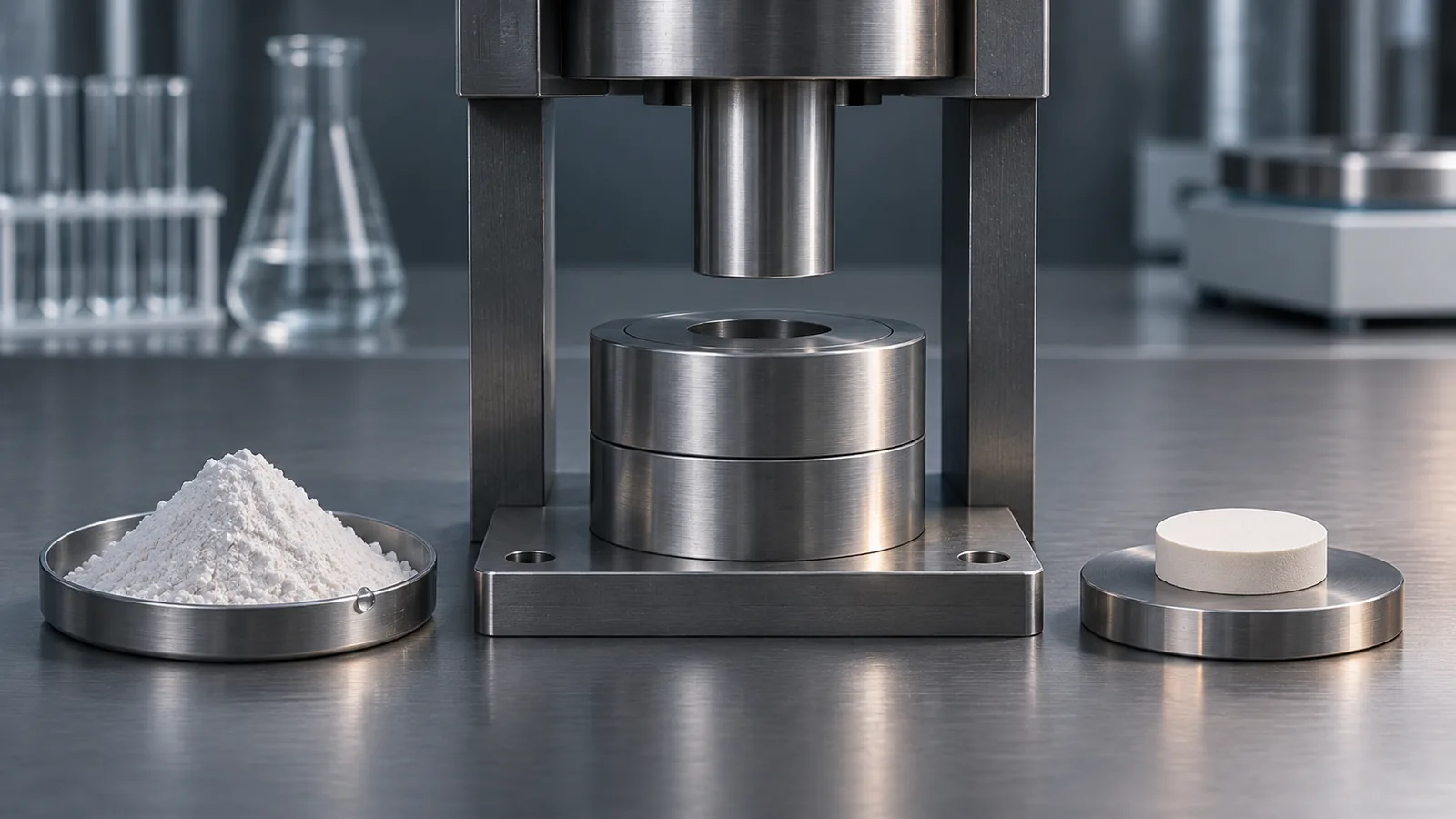
Water-assisted cold sintering uses a small amount of water as a transient liquid phase to consolidate powder under heat and pressure. In a study published online in Healthcare Materials on November 12, 2026, Lopes dos Santos and colleagues applied the process to wet-chemically synthesized hydroxyapatite (HAp). They examined the relative density and microstructure of the resulting ceramics.
Conditions for Water-Assisted Cold Sintering
The researchers used 10 wt% water as the sole transient liquid phase. They processed specimens at 175–225 °C and 400–500 MPa for 30 minutes. Water content, applied pressure and temperature together define the conditions tested. Equipment selection needs to account for both the heating temperature and the pressure the die must withstand.
The Highest Mean Relative Density Was 85.91%
The authors reported relative densities above 80% under all conditions tested. The group processed at 400 MPa and 225 °C had the highest mean, 85.91%. Relative density expresses specimen density as a fraction of the theoretical density and describes the degree of consolidation.
The study detected no statistically significant differences in density among the conditions tested. Increasing pressure did not produce a consistent gain over the range studied. When evaluating a particular temperature and pressure for a given powder, group means, variation between specimens and results from repeat batches can be assessed together.
What Fracture Surfaces and XRD Show
At 400 MPa and 225 °C, the authors observed a more uniform, continuous fracture surface. Elemental maps showed no pronounced segregation. X-ray diffraction (XRD) identified HAp as the predominant detectable crystalline phase after processing and indicated nanometer-scale coherent diffraction domains. Fracture surfaces show local microstructure, while XRD domain size describes the length over which a crystal diffracts coherently. Porosity in the ceramic and particle size distribution in the starting powder require their own measurements.
Qualifying Powder Batches and Pressed Parts
When changing hydroxyapatite powder batches, record particle size distribution, specific surface area and phase composition. With water content and pressing conditions held constant, compare relative density, residual porosity and the phases detected after sintering. For larger pellets, density and cross sections can be checked at the center and edge, with repeat batches used to assess consistency.
The experiment reports consolidation and microstructure. Compressive or flexural properties should be measured for the intended part, with biocompatibility and suitability for a specific use assessed in separate studies.
Original Research
Lopes dos Santos J, Menezes Lima A, Braga Dantas L, Antunes Ribeiro A, Poubel Mendonça da Silveira PH. Water-Assisted Cold Sintering of Hydroxyapatite: Effects of Pressure and Temperature on Densification and Microstructure. Healthcare Materials. 2027, 1(1), 2. Published online November 12, 2026. DOI 10.3390/healthcmater1010002.
The cover illustrates the powder, pressing die and ceramic pellet.