Sans and colleagues reported a route to hydroxyapatite (HAp) nanoparticles in ACS Applied Bio Materials. They pre-ground and mixed calcium chloride and diammonium hydrogen phosphate, then exposed the solid precursors to low-pressure oxygen plasma. The study examined the phases in the solid product, the size of particles dispersed in water, and their effect on the mechanical properties of alginate hydrogels.
Pre-grinding and Low-Pressure Plasma Treatment
The researchers compared nitrogen and oxygen plasmas under several discharge conditions. The resulting phase composition varied, with octacalcium phosphate (OCP) and dicalcium phosphate dihydrate (DCPD) also detected in some samples. To prepare CaP10, the authors treated the pre-ground solid mixture in oxygen at 0.8 mbar for 300 seconds using a 50% power setting. They attributed the effect of pre-grinding to a larger solid surface area exposed to the plasma.
The reported 300 seconds covers the discharge step. A comparison of processing times would also include grinding, mixing, loading and particle recovery. The plasma treatment of the solid precursors was solvent-free. Subsequent recovery, dispersion and hydrogel preparation used water. When reproducing the process on another instrument, the delivered power, loading and arrangement of the solids should be recorded, as 50% was the setting on the authors’ instrument.
Raman Phase Estimates and Particle Size
Raman band areas gave an estimated relative contribution of 66.9 ± 4.1% for HAp in CaP10, with 33.1 ± 2.5% for DCPD and a small contribution from OCP. These semi-quantitative values allow comparison of phase composition under the same analytical method. Determining the HAp mass fraction or the amount of HAp recovered per batch would require a validated quantitative phase method and a record of how much product was recovered.
The authors also used two indices based on Raman band areas to assess precursor conversion. C(HAp) indicates the relative extent of phosphate precursor conversion to HAp, while the complete reaction efficiency index (CRE) reflects overall precursor conversion to calcium phosphate products. The relative HAp contribution describes the balance of HAp and the other calcium phosphate phases in the product.
Extending the discharge to 1,800 seconds gave a relative HAp contribution of 56.2 ± 5.4% in CaP11. Its C(HAp) reached 1.16 ± 0.06, the highest value in Figure 4, while CRE fell from 2.1 ± 0.1 for CaP10 to 0.2 ± 0.1 for CaP11.
Reducing the oxygen pressure to 0.3 mbar increased CRE to 2.6 ± 0.05 in CaP12 (Figure 5). The relative HAp contribution fell to 21.2 ± 3.5%, and the DCPD contribution rose to 64.2 ± 4.0%. Under these conditions, lower oxygen pressure gave a higher CRE while shifting the phase composition toward DCPD. Screening conditions for HAp synthesis therefore calls for looking at overall conversion alongside the phases formed.
The researchers used 20 minutes of sonication in water to detach the CaP10 product from carbon tape. Unreacted calcium chloride and diammonium hydrogen phosphate dissolved, and HAp particles remained in suspension. High-resolution transmission electron microscopy (HRTEM) images in Figure 7 showed mainly spherical or near-spherical particles. Analysis of 65 particles gave a mean size of 5.5 ± 2.5 nm.
That mean describes individual particles measured in images after sonication. To compare how powder batches disperse during mixing, a separate size distribution can be measured with the dispersion medium, solids content and sonication conditions held constant. If agglomerates fall within the working range of a laser diffraction method, volume-based D50 and D90 values can help compare batches.
Hydrogel Stiffness Depends on the Formulation
Figure 11 includes two sets of alginate hydrogels prepared using the same order of addition. In Table 2, both sets started with 1 mL of a 3.9 wt% sodium alginate solution. To prepare the CaP10 suspension, the researchers detached the product from carbon tape by sonicating it in 2 mL of Milli-Q water for 20 minutes. In the crosslinking step, they added 0.5 mL of calcium chloride solution and 0.5 mL of CaP10 suspension. Each blank used an equal volume of water in place of the suspension. The 3 wt% and 6 wt% values refer to the calcium chloride crosslinking solutions before mixing.
With the 3 wt% solution, the blank had a compressive elastic modulus of 14.1 ± 2.7 kPa. Adding the particles significantly increased the modulus (p < 0.05). The paper gives two different modulus values for the same HAp(2)-Alg/3/0.5 formulation, so the result here is based on the reported statistical comparison with the blank.
With the 6 wt% solution, the blank measured 25.0 ± 8.4 kPa and the formulation with particles measured 12.9 ± 2.4 kPa. Adding the same volume of suspension changed the modulus in opposite directions in these two comparisons.
Drawing on X-ray photoelectron spectroscopy (XPS), the authors proposed that calcium sites on the HAp surface could form additional crosslinks with available carboxylate groups in alginate. When testing other HAp powders, the concentration and volume of the crosslinking solution and the order of addition can be held constant, with an equal-volume water blank tested under the same compression conditions.
What Scale-Up Would Need to Measure
The laboratory experiments used approximately 0.25 g of solid mixture per loading. At higher loadings, samples from different positions in the same batch could show whether phase composition varies with bed thickness or position. Measuring product recovery, phase composition and residual precursors across batches would help determine whether higher loadings give reproducible results.
For a composite formulation, qualification of a hydroxyapatite powder can start with phase identification and particle sizing under specified dispersion conditions. The next step is to measure performance in the intended matrix. For an alginate system, this means specifying whether the acceptance criterion is compressive elastic modulus, maximum compressive strength, or both, along with the formulation and test conditions.
Original Research
Sans J, Astorga A, Arnau M, Mingot J, Sánchez M, Alemán C. Solvent-Free Plasma-Assisted Synthesis of Hydroxyapatite Nanoparticles: Preparation, Characterization and Incorporation into Alginate Hydrogels. ACS Applied Bio Materials. 2026, 9(20), 9859–9875. DOI 10.1021/acsabm.6c01537.
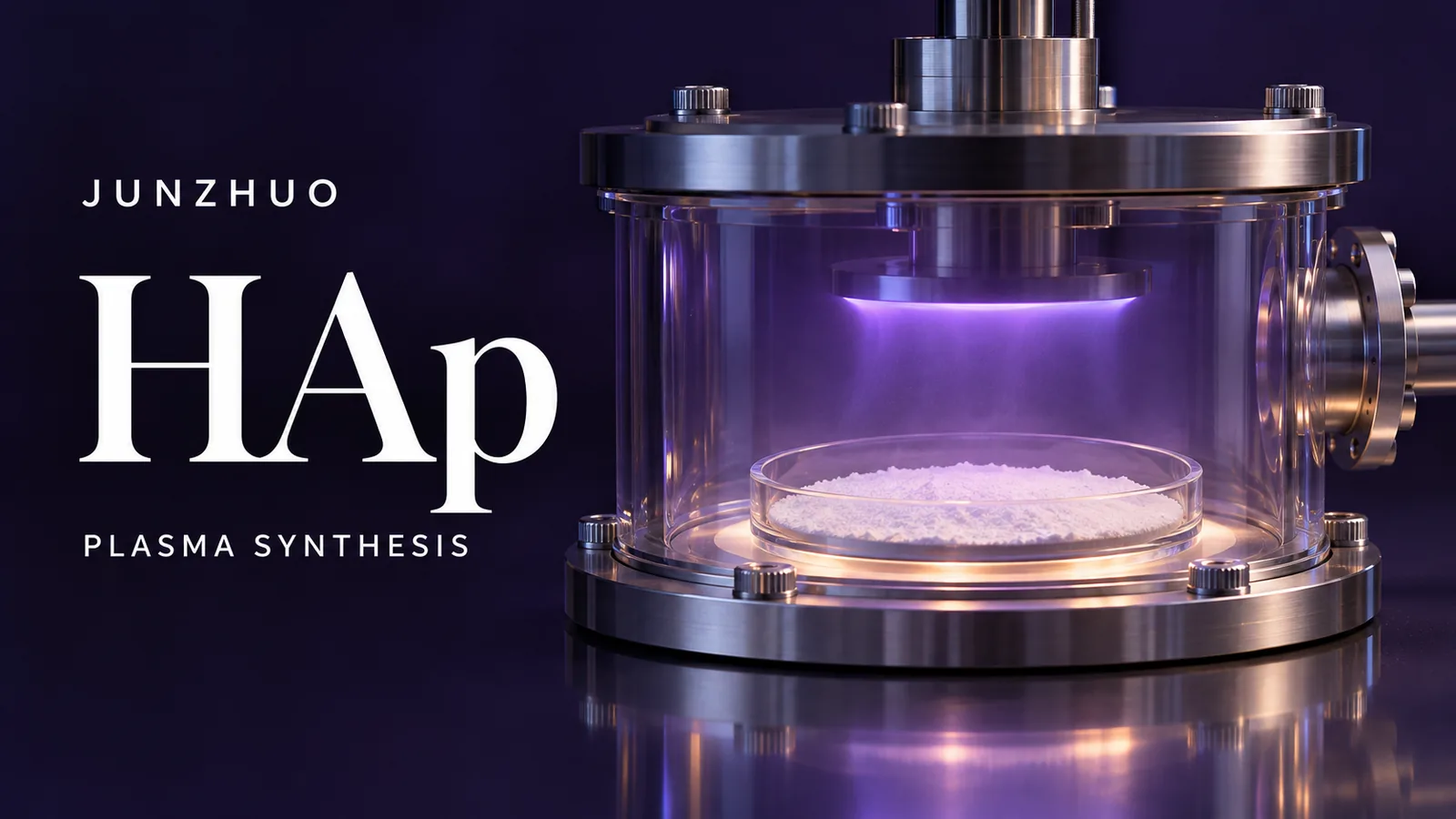
The cover is a conceptual illustration of plasma processing.