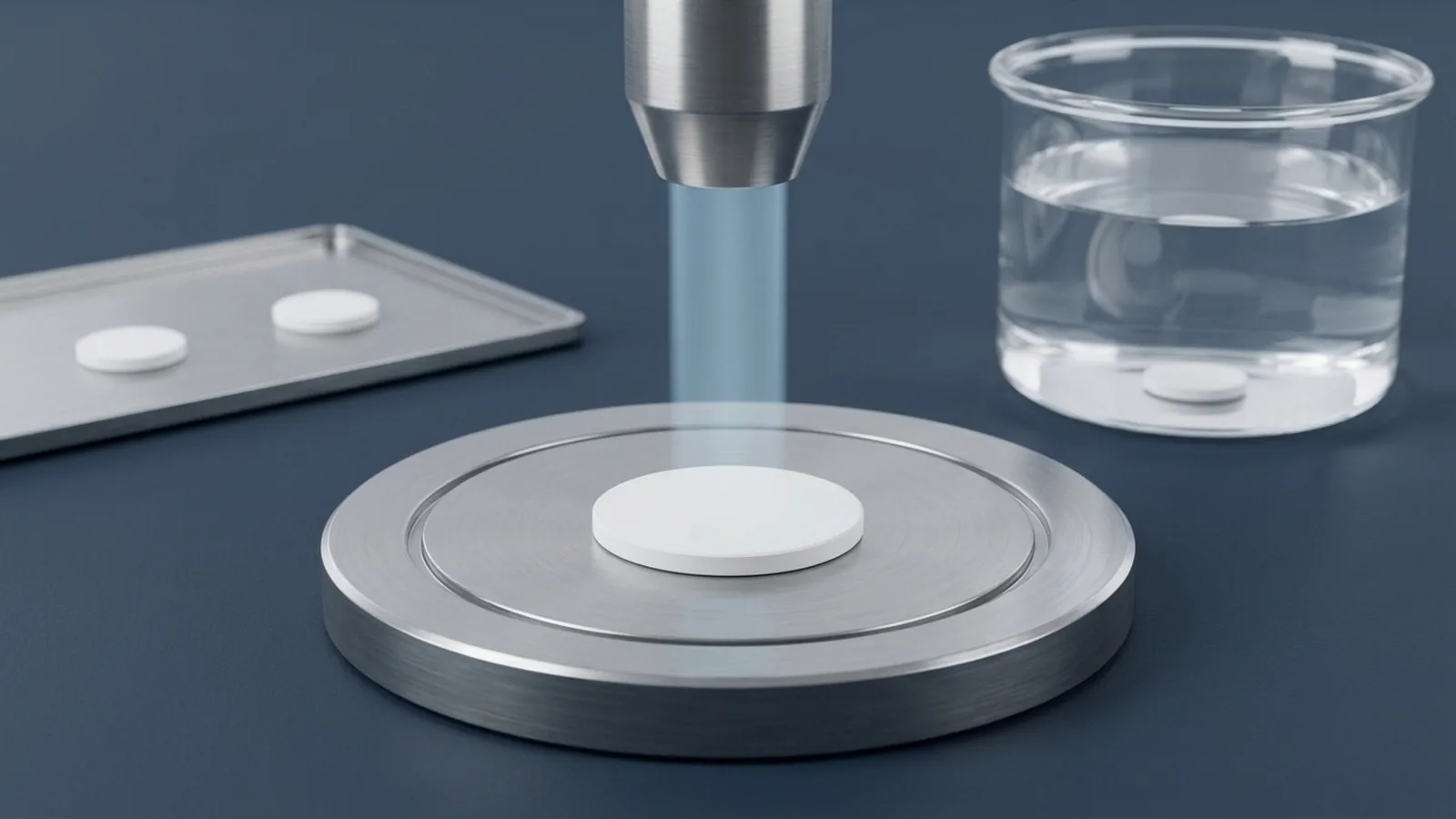
Whether hydroxyapatite ceramics retain their crystalline phase and dissolution behavior after exposure to ionizing radiation is a specific question in material stability assessment. Any conclusion needs to be tied to the fabrication route, radiation type and dose range.
A study by Khachatryan and colleagues, published early online in Discover Materials on November 25, 2026, examined the irradiation response of hydroxyapatite discs fabricated by digital light processing (DLP). This overview is based on the publisher’s public abstract, covering material characterization and in vitro solution-immersion experiments.
Two irradiation conditions
DLP-fabricated HAp ceramic discs were exposed to ultrashort electron-beam or X-ray irradiation, with non-irradiated specimens serving as controls.
The electron-beam energy was 3.6 MeV, with doses of 7–52 Gy. The X-ray dose range was 20–150 Gy. Energy describes the energy of an individual particle, while absorbed dose describes the radiation energy absorbed per unit mass; these are distinct parameters.
X-ray diffraction (XRD) and scanning electron microscopy (SEM) were used to compare phases and microstructure. Immersion in simulated body fluid (SBF) and Tris buffer was used to examine apatite formation and dissolution behavior.
No detectable phase or morphological changes
The public abstract reports that all irradiated specimens retained the characteristic HAp phase within the investigated dose ranges. No noticeable phase transformation, diffraction peak shift or microstructural change was observed.
This finding is limited by the sample system and the sensitivity of the methods. An absence of noticeable changes in XRD and SEM does not exclude every possible lattice defect, surface-chemical change or mechanical-property change; those questions require targeted measurements.
Comparable in vitro mineralization and dissolution
The groups showed similar apatite formation after SBF immersion and comparable degradation profiles in Tris buffer. The authors reported no detectable systematic differences between irradiated and non-irradiated specimens.
These observations support a comparison of in vitro mineralization and dissolution under the tested conditions. Apatite formation in SBF does not establish bone regeneration, and solution-immersion experiments do not replace cell, animal or clinical evaluation.
From ceramic discs to product-specific validation
The study concerns ceramic discs made by a specific DLP route. Its findings cannot be transferred directly to HAp powders, microspheres or composites containing organic components. Differences in particle size distribution, phase composition, crystallinity and pore structure may affect processing response and immersion behavior.
For comparison, ISO 11137-2 describes methods for substantiating 15 kGy or 25 kGy as radiation sterilization doses. These doses are 100 and about 167 times the study’s highest absorbed dose of 150 Gy, respectively. The study evaluated material stability. The sterilization dose, dose distribution and post-treatment performance still require product-specific validation.
Nanjing Junzhuo supports downstream R&D with HAp raw materials and documentation, focusing on particle size distribution, phase purity, pore characteristics and batch consistency. Suitability after irradiation should be confirmed for the specific formed material, formulation and treatment conditions.
Original research
Khachatryan A, Asatryan K, Aghayan M, et al. Structural stability and biological response of DLP-fabricated hydroxyapatite discs following ultrashort electron-beam and x-ray irradiation. Discover Materials. 2026. Published early online: November 25, 2026. DOI: 10.1007/s43939-026-01099-z.
The publisher identifies this as an early version of an accepted article, subject to further editing.