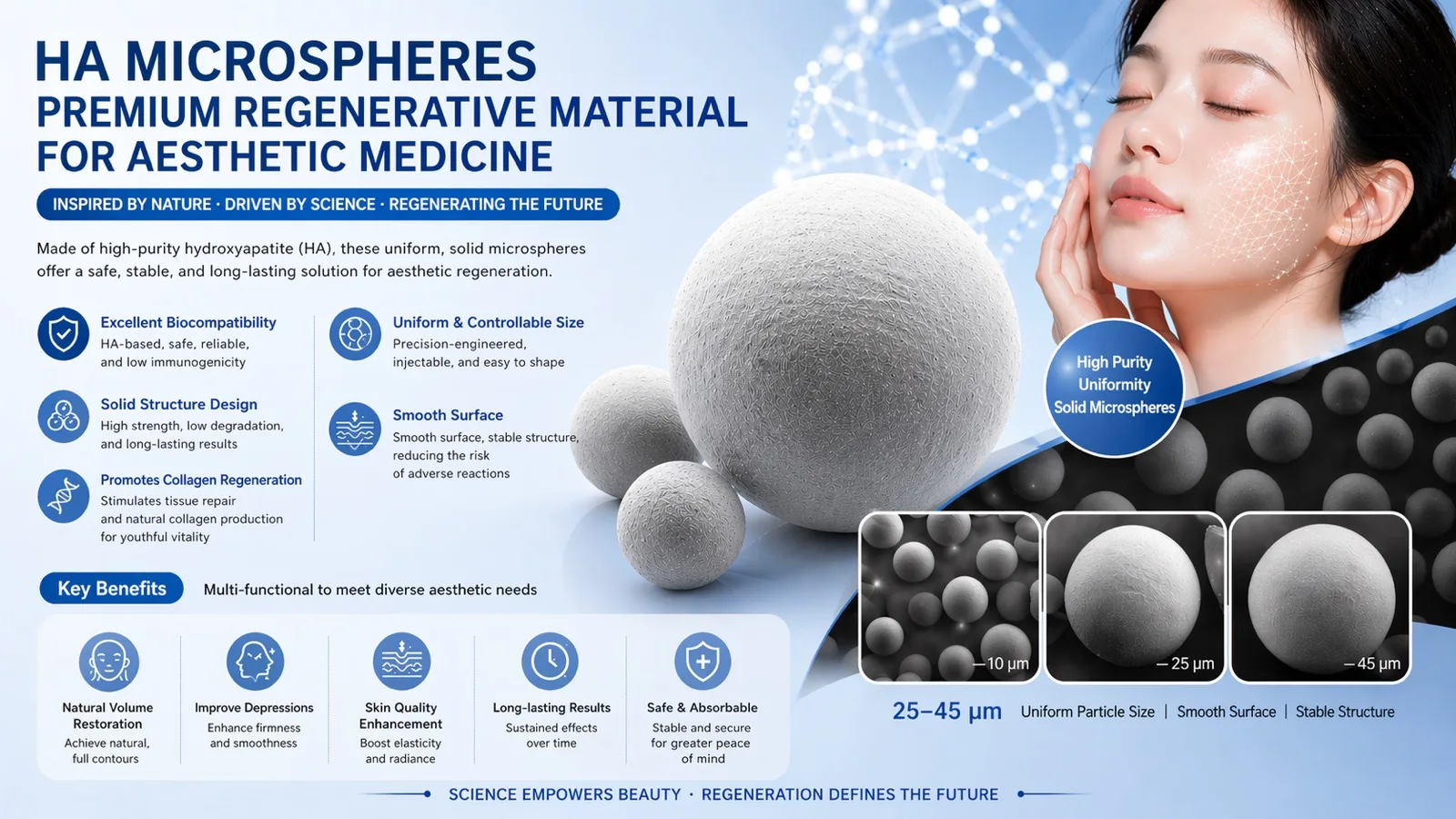
Why Solid Microspheres Matter in Aesthetic Materials
Aesthetic injectable materials are moving beyond simple volume replacement toward a broader design logic that combines structural support, tissue response, and long-term formulation stability. In this context, hydroxyapatite (HA/CaHA) microspheres have become an important material platform for regenerative aesthetic development because of their biocompatibility, mineral composition, and controllable particle morphology.
Compared with loose, porous, or irregular particles, solid hydroxyapatite microspheres place more emphasis on density, sphericity, and particle-size consistency. For injectable systems dispersed in a gel carrier, these characteristics can influence flow behavior, injection feel, local distribution, and batch-to-batch repeatability.
Material Advantages of a Solid Spherical Structure
The key value of a solid microsphere is stability. A dense spherical structure can reduce fragments and fine particles, helping create a more uniform particle system. A smooth and rounded surface also supports better dispersion in the carrier and helps reduce the risk of uneven aggregation.
For aesthetic-grade materials, developers typically need to review particle-size window, surface morphology, purity, residual control, and lot consistency. CaHA microspheres for aesthetic applications are often designed around ranges such as 25-45 μm, balancing injectability, local scaffold behavior, and formulation stability.
How Solid CaHA Microspheres Fit Aesthetic Regeneration
CaHA microspheres are usually not used as a standalone injectable product. Instead, they are dispersed as an inorganic particle phase within a suitable gel system. The carrier provides early flow and immediate support, while the microspheres act as a longer-term microscale scaffold that supports local tissue response and extracellular matrix remodeling.
From an application perspective, solid hydroxyapatite microspheres are especially relevant for projects focused on contour support, soft-tissue structure improvement, composite filler systems, and regenerative aesthetic materials. Their value lies not only in filling volume, but also in providing a controlled and stable material basis for formulation design.
Key Quality Points for Aesthetic-Grade Microspheres
For aesthetic applications, it is not enough to confirm that a particle is chemically CaHA. Development teams also need to evaluate sphericity, particle-size distribution, surface smoothness, particle integrity, impurity profile, endotoxin control, dispersion performance, and sterilization compatibility. Variability in any of these areas may affect later formulation work and product validation.
For R&D teams and brand owners, a stable upstream microsphere material can shorten formulation screening and help establish clearer quality standards. In composite gels, dual-phase systems, or longer-support materials, batch consistency of solid microspheres often determines whether a project can move forward efficiently.
How Nanjing Junzhuo Supports Material Development
Nanjing Junzhuo Biotechnology Co., Ltd. focuses on the research, production, and application support of advanced bioceramic materials. For solid hydroxyapatite microspheres, Junzhuo can support projects around particle-size control, morphology optimization, purity management, documentation, and stable scale-up production.
As regenerative aesthetic materials continue to evolve, solid CaHA microspheres will remain an important raw-material direction for differentiated product development. For teams seeking a stable, controllable, and technically clear material route, selecting the right solid hydroxyapatite microsphere is an important step from concept design to product validation.