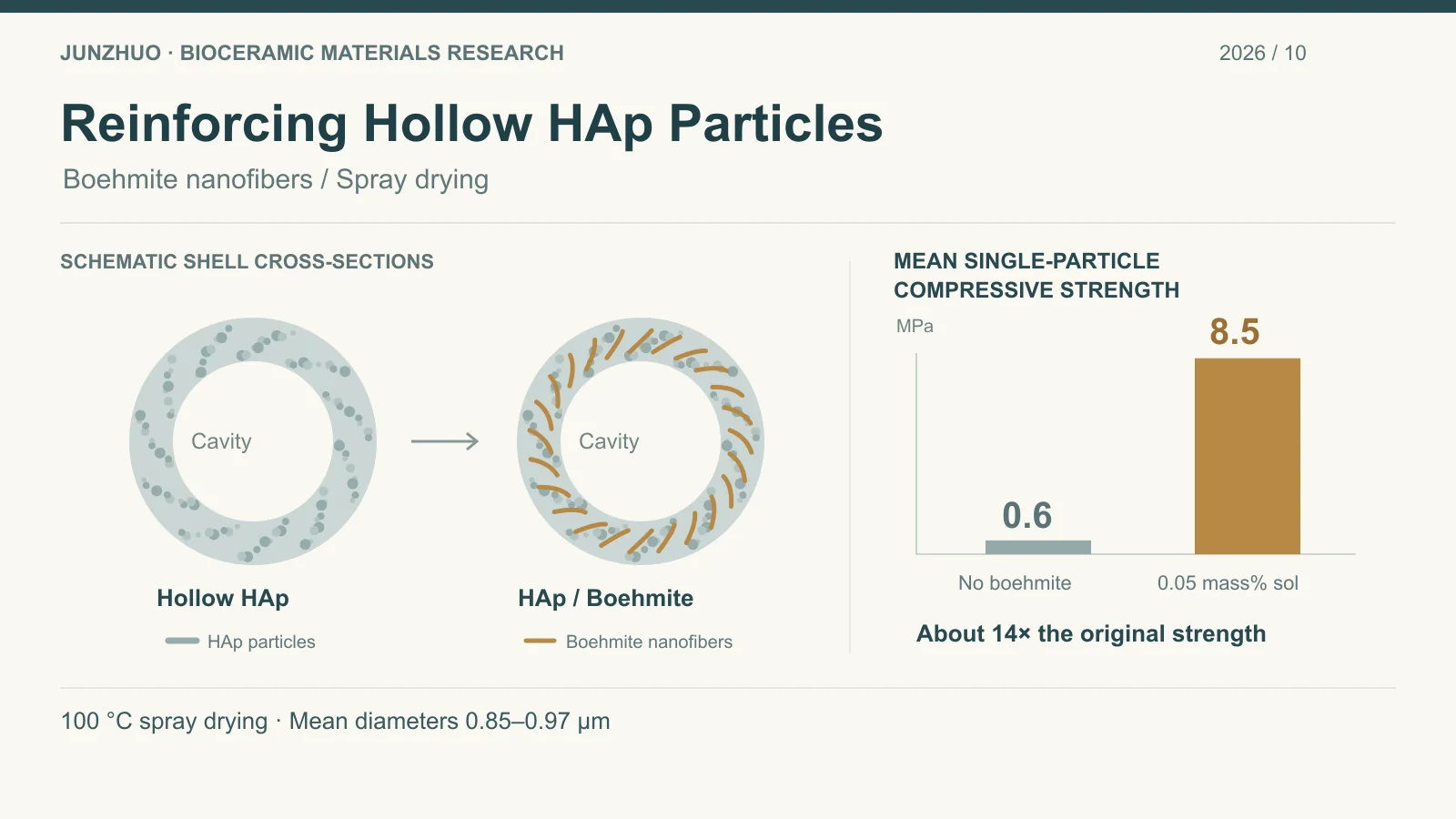
The shell of a hollow hydroxyapatite (HAp) particle consists of aggregates of fine crystallites. The internal cavity provides a lightweight structure but leaves the shell vulnerable to failure under pressure. Improving load-bearing capacity while retaining that cavity is a practical challenge when developing hollow particles as functional fillers.
In a study published in Powders on October 10, 2026, Takeshi Toyama and Nobuyuki Nishimiya of Nihon University incorporated boehmite (AlOOH) nanofibers into hollow HAp particles by spray drying. Under the selected preparation conditions, average single-particle compressive strength rose from approximately 0.6 to 8.5 MPa, about 14 times the value for particles without boehmite.
Reinforcing the Shell While Retaining Hollow Particles Around 1 μm
The researchers suspended HAp powder in water and introduced carbon dioxide to promote dissolution. They filtered out undissolved particles, then mixed the resulting aqueous solution with a boehmite nanofiber sol. The fibers were approximately 4 nm in diameter and up to 1,400 nm long. The purpose of using this high-aspect-ratio reinforcement was to incorporate fibers alongside the HAp particles forming the shell as droplets dried and HAp precipitated.
The drying temperature was set to 100 °C and the atomizing pressure to 200 kPa. Average particle diameters ranged from 0.85 to 0.97 μm across the preparation conditions. These values came from SEM image analysis of at least 30 particles per condition. TEM confirmed hollow structures in both the sample without boehmite and the sample prepared with 0.05 mass% sol addition.
Sol Addition and Estimated Dry Composition Are Different Quantities
The reported 0.05 mass% is the mass of added boehmite sol relative to the total mass of the mixed solution. The sol contains substantial water and has an Al₂O₃-equivalent solids content of 4.5–5.1 mass%. Its addition level therefore cannot be read directly as the boehmite content of the finished particles.
Using the minimum guaranteed solids content of 4.5 mass% and the stoichiometric relationship between Al₂O₃ and AlOOH, the authors calculated the expected boehmite fraction on a dry-solid basis. Sol additions of 0.05 and 0.10 mass% corresponded to estimated boehmite contents of approximately 11.9 and 21.3 mass%, respectively. These are formulation-based estimates, rather than direct measurements of the final particle composition.
At 0.10 mass% sol addition, the researchers observed increased feed viscosity, nozzle clogging, and irregular particles. Of 83 particles classified in SEM images under this condition, approximately 25% were irregular. Reinforcement loading was therefore constrained by atomization and particle formation. The 0.05 mass% level was suitable for stable preparation with spherical morphology under the tested conditions; it is not a universal formulation for other equipment.
What the 8.5 MPa Single-Particle Measurement Shows
A flat indenter was used to compress individual particles, and compressive strength was calculated from the maximum load at failure and particle size. For each condition, the researchers selected 10 spherical particles with sizes close to the corresponding average. Mean strength was approximately 0.6 MPa without boehmite and 8.5 MPa at 0.05 mass% sol addition.
| Comparison | Without boehmite | 0.05 mass% sol addition |
|---|---|---|
| Particle system | Hollow HAp particles | Hollow HAp/boehmite composite particles |
| Estimated dry boehmite fraction | 0 | Approximately 11.9 mass% |
| Mean single-particle compressive strength | Approximately 0.6 MPa | Approximately 8.5 MPa |
| Particles tested for strength | 10 | 10 |
The ratio of the two means is approximately 14.2, supporting the description “about 14 times the original strength.” The test establishes a difference among the selected particles under this loading method. It does not determine how much of a powder batch would fracture during mixing, conveying, or molding.
The authors also compared 8.5 MPa with an 8 MPa hydrostatic-pressure reference used in a Japanese VSI standard for hollow volcanic-glass particles. Single-particle compression and hydrostatic testing apply different loading conditions and evaluate different outcomes. The comparison does not establish that this composite powder has passed that standard.
Fibers Were Observed in the Shell; Their Contribution Needs Further Study
TEM showed shells made mainly of fine HAp particle aggregates in the sample without boehmite and fibrous structures within the composite shells. The authors proposed that nanofibers may reinforce connections between HAp particles, allowing the shell to withstand higher loads.
The TEM observations are two-dimensional and do not directly demonstrate a complete three-dimensional entangled network. The authors also noted that changes in HAp precipitation and interparticle bonding after boehmite addition could affect strength. The supported conclusion is that fibrous structures in the shell accompanied the strength increase; the contributions of the individual mechanisms remain to be separated.
XRD showed no clear change in the HAp crystalline phase and no distinct new peaks attributable to crystalline byproducts such as calcium aluminate. The broad diffraction peaks, however, do not rule out low-crystallinity byproducts or interfacial chemical interactions that do not produce a separate crystalline phase.
For Lightweight Fillers, Cavity Retention After Processing Is the Next Question
The study primarily considers the particles as potential lightweight functional fillers. A direct next step for that use would be to incorporate them into a specified matrix and assess cavity retention, particle fracture, composite density, and mechanical properties after actual mixing and molding. This would test whether higher single-particle strength translates into structural survival during processing. These are proposed development evaluations; the paper did not carry them out.
On the preparation side, the relationship between feed viscosity, atomization, and particle morphology needs further evaluation. Clogging and irregular morphology at 0.10 mass% show that process stability can limit reinforcement loading. Pursuing a higher compression value alone may not yield stable powder production.
The paper discusses microcapsules, drug delivery, and adsorption in its background, but this experiment did not assess drug loading, release, or biocompatibility. Hollow, boehmite-containing composite particles around 1 μm should also be considered separately from CaHA microspheres used in aesthetic injectables. The work provides material-level results on shell reinforcement and spray-dried particle formation.
Research Source
Toyama, T.; Nishimiya, N. Preparation of Nanofiber-Reinforced Hydroxyapatite/Boehmite Composite Hollow Spherical Particles Using Spray Drying. Powders. 2026;5(4):40. Published October 10, 2026. DOI: 10.3390/powders5040040.