Hydroxyapatite (HAp) is widely studied in bone-repair materials, implant-surface coatings, and tissue engineering. It resembles the principal inorganic mineral in bone. Used on its own, HAp remains brittle. It is also not generally expected to provide strong, stable intrinsic antibacterial activity.
Combining HAp with CuO or ZnO is one way to investigate antibacterial behavior alongside resistance to local indentation. This is not simply a matter of adding a functional label to HAp: particle state, dispersion, loading, and processing all change the material system that cells and microorganisms encounter.
A 2026 Ceramics International in vitro study used a citric-acid-assisted hydrothermal route to prepare HAp/CuO and HAp/ZnO composites. It compared structure, Vickers microhardness, inhibition zones, and L929 cell viability. The useful feature of the study is not a universal formulation, but a side-by-side view of measures that are often discussed separately.
These Were Composite Structures, Not Simple Powder Blends
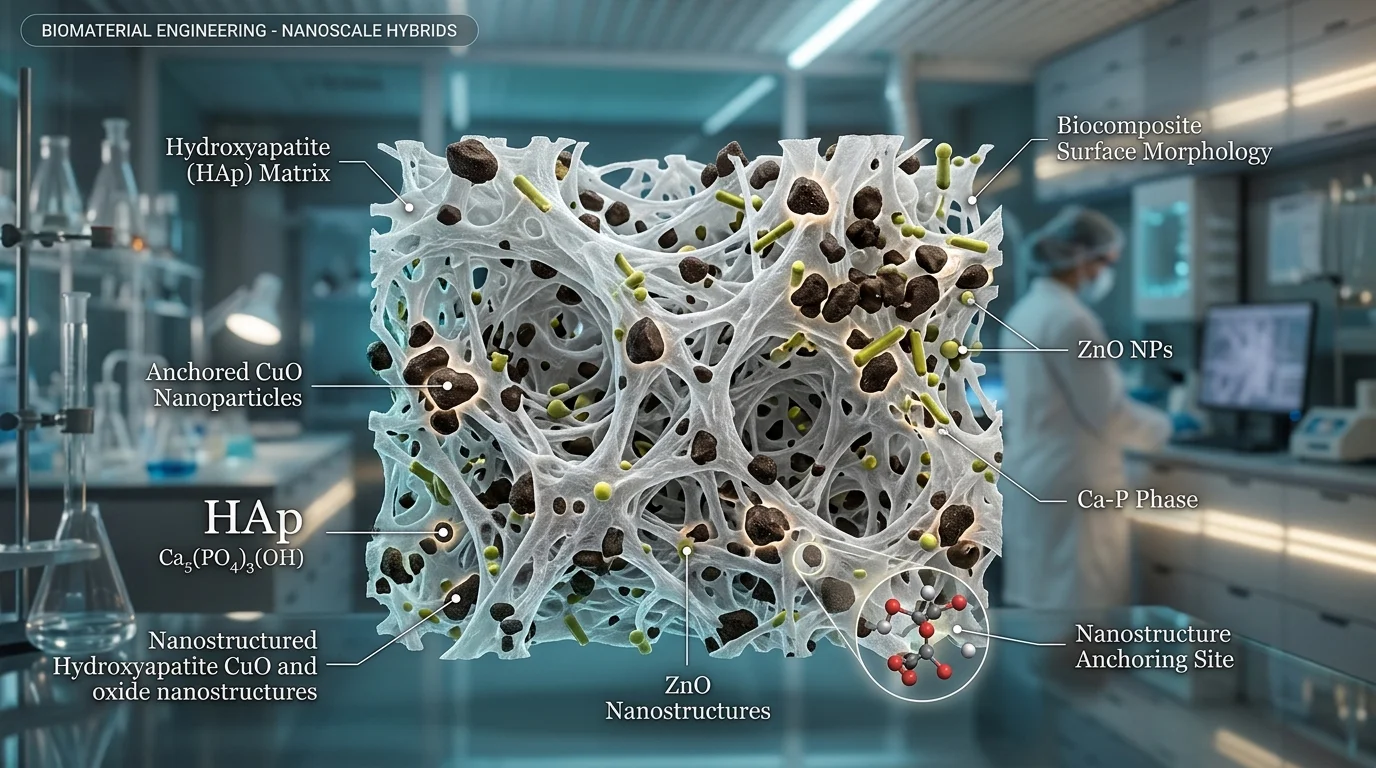
The researchers used XRD, FTIR, Raman spectroscopy, and XPS to examine structure and surface chemistry. Their results supported the coexistence of HAp with monoclinic CuO or wurtzite ZnO in the composites. Microscopy showed HAp nanoparticles dispersed and anchored on larger CuO or ZnO nanostructures.
That distinction matters. Material behavior depends not only on the elements listed in a formulation, but also on how particles meet, disperse, and remain at the interface after processing.
Higher Microhardness Does Not Resolve Every Mechanical Question
In Vickers microhardness testing, HAp/CuO measured about 247 Hv and HAp/ZnO about 191 Hv. Under this test, the CuO composite resisted local indentation more effectively.
Microhardness answers one local surface question. It does not substitute for fracture toughness, fatigue, coating adhesion, or mechanical retention after long-term immersion. These data support higher hardness for HAp/CuO under the study conditions; they do not establish that CuO makes every HAp structure more stable.
Larger Inhibition Zones Are Not an Infection-Prevention Result
The study measured inhibition zones against Enterococcus faecalis, Escherichia coli, Pseudomonas aeruginosa, and Staphylococcus aureus. Both composites showed concentration-dependent inhibition, while HAp/CuO produced larger zones overall across the four test strains.
An inhibition zone shows that a material can suppress growth of a test organism under a defined culture condition. It does not show control of a surface biofilm or establish how long the effect would persist in a physiological environment. For implant-related materials, biofilm behavior, ion release, and surface changes after long-term immersion still require separate testing.
Cell Viability Must Be Read Alongside the Other Results
The authors used an MTT assay with L929 mouse fibroblasts. HAp/CuO maintained cell viability of about 98.94% at 10 μg/mL and 80.08% at 50 μg/mL. HAp/ZnO showed about 33.06% viability at 50 μg/mL. The published abstract explicitly reports this concentration; this article does not present it as a complete concentration-response comparison.
In this cell model and time window, HAp/CuO retained comparatively higher viability at the higher test concentration. The result also shows why the fact that zinc is biologically relevant, or that ZnO is common in materials research, cannot by itself predict the cytocompatibility of a particular HAp/ZnO formulation. Particle size, surface state, release behavior, and test concentration all matter.
| What the study measured | What it observed | What it does not establish |
|---|---|---|
| Vickers microhardness | HAp/CuO about 247 Hv; HAp/ZnO about 191 Hv | Fracture toughness, fatigue, or load-bearing performance |
| Inhibition zones for four bacteria | HAp/CuO produced larger inhibition zones overall across the four test strains and varied with test concentration | Biofilm control, in vivo infection prevention, or duration of effect |
| L929 MTT cell viability | At 50 μg/mL, HAp/CuO about 80.08%; HAp/ZnO about 33.06% | Long-term biological safety or human compatibility |
A Better Composite Must Balance All Three
The study did not present HAp/CuO as a universal answer. Under the study conditions, HAp/CuO showed higher microhardness and larger inhibition zones. At 50 μg/mL, the reported L929 cell viability was also higher than that of HAp/ZnO.
Ion release, long-term immersion, fracture and fatigue behavior, and testing closer to real-use conditions still need to be addressed. For HAp composites, antibacterial behavior, local hardness, and cytocompatibility should be evaluated together, rather than judged by whichever individual result appears strongest. A composite is worth further study only when these results can hold together for the intended application.
This article discusses material characterization and in vitro results for HAp/CuO and HAp/ZnO composites. It does not recommend a specific medical product, clinical indication, or treatment approach.
Reference
- Biju RF, Samy SAD, Jaffrin G, John ML, Mani JAM. Physicochemical, mechanical, antibacterial and cytotoxicity evaluation of hydroxyapatite anchored ZnO and CuO as potential composite biomaterials. Ceramics International. 2026;52(16):31080–31094. DOI: 10.1016/j.ceramint.2026.05.176.