
Hydroxyapatite (HAp) is one of the most widely studied calcium phosphate bioceramics. Its chemical composition is close to the inorganic mineral phase in human bone and teeth, which is why HAp has long been used in bone repair, dental materials, implant coatings, tissue-engineering scaffolds, and localized delivery research.
A recent review published in MDPI Materials, Calcium Phosphate Nanostructured Biocomposites with Applications in Bone Tissue Engineering, summarizes research progress in calcium phosphate nanostructured biocomposites for bone tissue engineering. One important message from the review is that calcium phosphate performance is not simply determined by whether a material is HAp. It is shaped by phase composition, Ca/P ratio, particle size, micro- and nanostructure, porosity, synthesis route, composite design, and surface functionalization.
For HAp/CaHA raw-material development, this has practical relevance. The path from experimental materials to reproducible application studies depends on more than novelty; it also depends on whether the underlying physicochemical parameters are stable, clearly defined, and traceable.
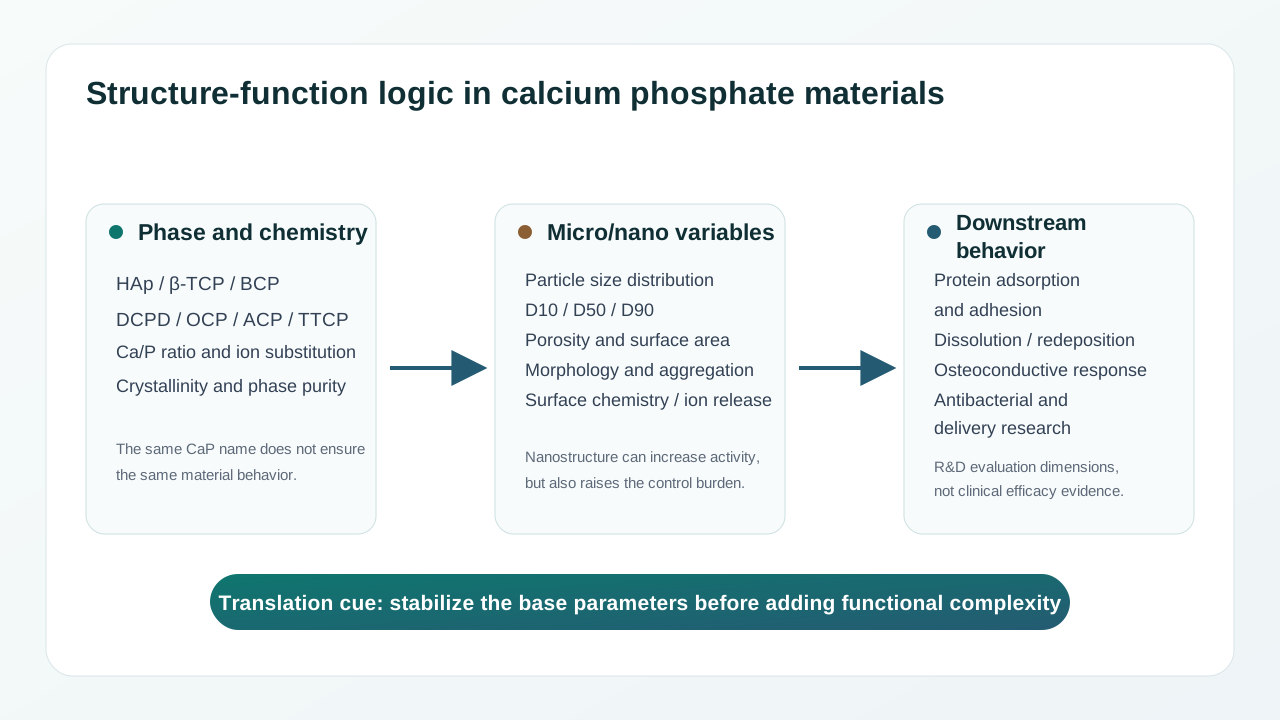
Calcium Phosphate Materials Are a Tunable Family, Not a Single Material
The review first clarifies that calcium phosphate materials are not a single category. In addition to HAp, phases such as DCPD, TCP, TTCP, OCP, and ACP each have their own solubility, crystal structure, stability, and application boundaries. Even within TCP, α-TCP and β-TCP differ in crystal structure, density, and dissolution behavior, leading to different application profiles.
This means calcium phosphate R&D cannot stop at the material name. HAp is usually associated with relatively high stability and slower degradation; β-TCP is widely used in resorbable bone-repair research; BCP adjusts the ratio between HAp and TCP to balance structural stability with resorbability. For downstream R&D teams, the variables that often shape experimental outcomes are phase composition, crystallinity, Ca/P ratio, and processing route.
The review also covers preparation routes for calcium phosphate materials, including co-precipitation, sol-gel processing, hydrothermal synthesis, mechanochemical routes, template-assisted methods, and microwave-assisted approaches. Different routes can produce different particle sizes, morphologies, specific surface areas, pore structures, and impurity risks. For HAp/CaHA raw materials, the same chemical name does not necessarily mean the same material behavior.
Nanostructure Increases Activity, and Also Raises the Control Burden
Calcium phosphate nanomaterials attract attention because natural bone mineral itself has nanoscale features. The review notes that nanostructure can increase surface area and create material behaviors distinct from micron-scale systems, including protein adsorption, cell-material interface response, ion release, and surface remineralization.
That does not mean smaller particles are always better. Nanomaterials are more surface-active, but they are also more prone to aggregation. Dispersion state, surface charge, particle size distribution, and batch stability all become harder to control. The review's discussion of particle size, micro/nano structure, and material morphology points to a practical issue: when material activity increases, the evaluation system must become more refined.
For this reason, particle-size control cannot rely on D50 alone. D10, D50, D90, span, particle morphology, sphericity, surface roughness, pore structure, and specific surface area should all be part of the raw-material evaluation window. For materials that may later enter composite scaffolds, bone cements, localized delivery systems, or injectable downstream formulations, a stable particle size distribution and controlled morphology are often more informative than a single average size value.
- Review insight: CaP material behavior is linked to particle size, surface area, porosity, morphology, and processing form. The material name alone is not enough.
- Raw-material insight: HAp/CaHA raw materials need a well-defined and verifiable specification window, so downstream teams do not mistake raw-material variation for formulation performance.
Composite Modification Is Structural Design, Not Simple Mixing
One focus of the review is the functionalization of calcium phosphate materials. It summarizes modification strategies such as ion substitution, surface coating, biomolecule immobilization, and the construction of composite systems with polymers, bioactive glass, metals, or oxides.
The core idea is not simply to add another material. The purpose is to alter material behavior through composition and interface design. For example, metal-ion substitution can be used to adjust antibacterial, osteogenesis-related, or ion-release behavior; natural polymers such as collagen, chitosan, hyaluronic acid, and alginate can mimic extracellular-matrix environments; synthetic polymers such as PCL, PLGA, and PLA can improve processability and mechanical support; bioactive glass can introduce additional bioactivity and ion-release features.
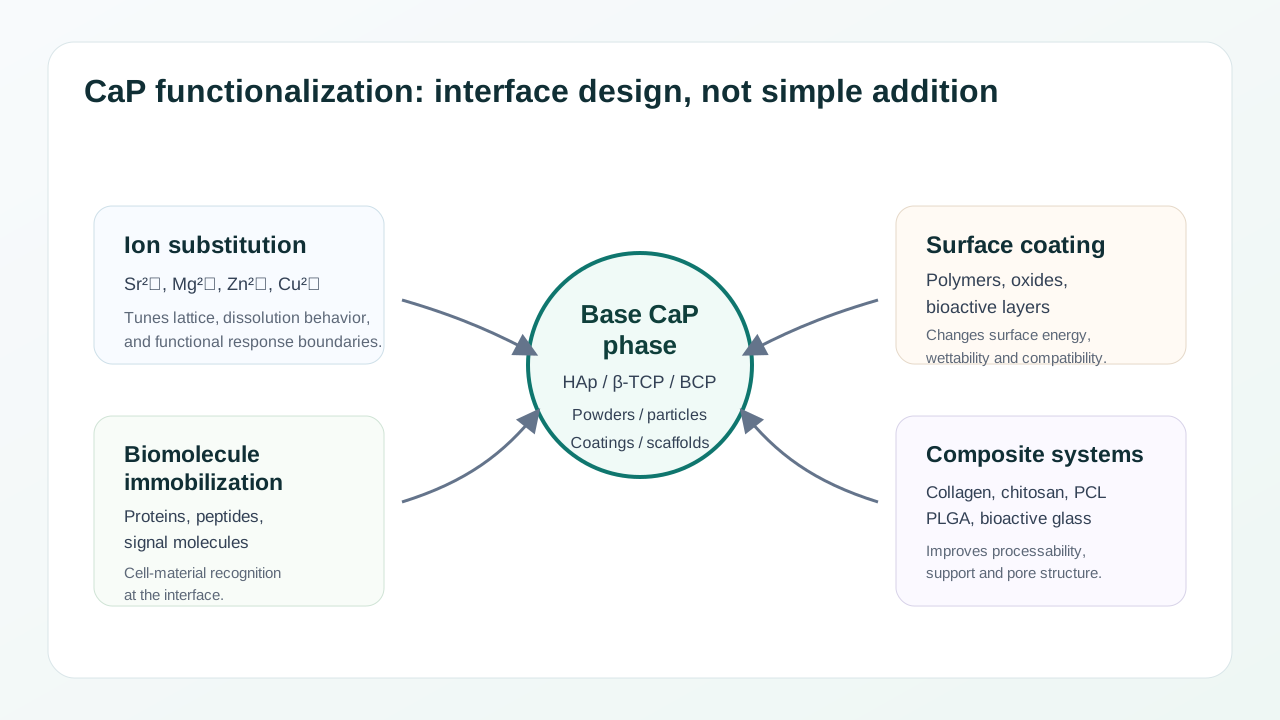
From a raw-material perspective, the more complex the composite system becomes, the higher the requirement for stable base HAp/CaHA materials. If upstream powders vary in phase composition, particle size, impurity profile, surface state, or moisture state, downstream teams may struggle to determine whether a performance change comes from formulation design or raw-material batch variation. Clear composite modification depends on a clear calcium phosphate base phase.
Material Performance Depends on Structure-Function Relationships
The review repeatedly emphasizes the need to connect composition, synthesis route, structural features, and biological performance in calcium phosphate composites. In other words, material evaluation should not stop at one endpoint indicator; it should ask why a certain result appears.
For example, pore structure can affect cell ingrowth, fluid exchange, and degradation. Crystallinity influences dissolution rate and ion release. Surface chemistry affects protein adsorption and cell adhesion. Phase composition changes the balance between stability and resorbability. For HAp/CaHA raw materials, these variables determine how controllable the material remains during downstream compounding, forming, and verification.
The review also notes that calcium phosphate nanocomposite research has expanded from conventional osteoconductivity-focused material response into more complex directions such as antibacterial response, anti-inflammatory design, immunomodulation, localized delivery, and theranostics. These directions are still mainly within the scope of material research and mechanistic exploration; they should not be read as evidence of clinical performance for any specific raw material or product. A more appropriate interpretation is that these directions expand the R&D boundary for HAp/CaHA raw materials and raise the bar for parameter control.
| Variable | Material logic in the review | Implication for raw-material development |
|---|---|---|
| Phase and Ca/P ratio | Different CaP phases differ in solubility, stability, and biological response. | A specification should define phase composition, Ca/P ratio, phase purity, and test methods rather than stopping at the HAp/CaHA name. |
| Particle size and morphology | Particle size, surface area, and material form can affect reactivity, cell interfaces, and dissolution/release behavior. | D10/D50/D90, span, sphericity, aggregation state, and particle integrity should be included in the evaluation window. |
| Porosity and surface | Pore structure and surface chemistry influence fluid exchange, protein adsorption, cell adhesion, and degradation. | Powders, microspheres, coatings, and scaffolds should each have surface and pore-evaluation methods suited to their use. |
| Functional interface | Ion substitution, coatings, biomolecule immobilization, and composite systems can change material response. | Before composite modification, the base raw material should be batch-stable to reduce bias from stacked variables. |
Batch Consistency Determines Whether R&D Results Can Be Reproduced
When laboratory materials move toward practical application, batch consistency becomes a core threshold for translation. Many variables covered by the review, including phase, particle size, morphology, porosity, composite route, ion release, and surface functionalization, need to remain comparable across batches.
During cell studies, animal studies, sterilization compatibility testing, registration-oriented testing, and scale-up, variation in particle size distribution, crystallinity, phase composition, impurity level, or surface state can create downstream variability. Such variability increases R&D cost and can affect project decisions.
For HAp/CaHA raw-material suppliers, the value is therefore not simply to provide powders or particles. The higher-value role is to provide stable, traceable, and verifiable material inputs. In composite scaffolds, bone cements, localized delivery systems, and regenerative-medicine material development, raw-material consistency often determines the efficiency of formulation screening and performance verification.
Nanjing Junzhuo's Focus at the HAp/CaHA Raw-Material Level
Nanjing Junzhuo Biotechnology Co., Ltd. has long focused on application-oriented research involving HAp/CaHA calcium phosphate materials in bone repair, dental materials, regenerative medicine, localized delivery, and non-load-bearing tissue-filling systems. In the context of calcium phosphate nanocomposite development, Junzhuo's focus is how upstream material parameters can provide a stable foundation for downstream R&D.
Across different research scenarios, Junzhuo works on specification control for HAp/CaHA raw materials, including particle size distribution, particle morphology, phase composition, crystallinity, density, surface state, impurity control, and batch consistency. For R&D projects that require further composite modification, process validation, or biological evaluation, stable base materials can reduce unnecessary variable interference.
For precision injection and non-load-bearing tissue-filling systems, Junzhuo has achieved standardized preparation of 25–45 μm fully solid, dense CaHA microspheres. For bone repair, composite scaffolds, localized delivery, and dental-related research, stable HAp/CaHA powders and microsphere materials can also support formulation screening, performance verification, and further development.
Conclusion
The review does more than summarize application directions for calcium phosphate nanostructured biocomposites. Its larger value is a framework for understanding how materials move toward application: from chemical composition to crystal phase, from particle size to porosity, and from surface functionalization to composite interfaces, each variable can affect final material behavior.
For HAp/CaHA bioceramics, long-term stability of fundamental parameters often matters more to downstream R&D quality than a single new concept. Particle size, morphology, phase composition, Ca/P ratio, pore structure, surface chemistry, and batch consistency all influence whether later development can be verified, reproduced, and scaled.
Nanjing Junzhuo will continue to focus on the stability, specification control, and application suitability of HAp/CaHA raw materials, providing stable upstream material inputs for R&D projects in bone repair, dental materials, regenerative medicine, localized delivery, and non-load-bearing tissue filling.
Reference
Petcu G, Anghel EM, Parvulescu V, Holban AM, Curutiu C, Ilie C-I, Ditu L-M. Calcium Phosphate Nanostructured Biocomposites with Applications in Bone Tissue Engineering. Materials. 2026;19(7):1375. DOI: 10.3390/ma19071375.