
For buyers of CaHA microspheres, 25–45 μm is often the first specification discussed. Nanjing Junzhuo can supply this size grade and provide solid or porous samples, but a nominal range alone is not an executable purchasing specification.
Buyers also need to define how the range is measured, whether the unit of analysis is an individual microsphere or an agglomerate, how out-of-range particles are counted, and whether routine lots will be tested on the same basis as the sample. The publicly available FDA instructions for RADIESSE state a 25–45 μm particle-size range, but this is a description of that finished device, not a universal standard for all CaHA microspheres [1].
A nominal range must be tied to a test method
A 25–45 μm range may refer to a nominal grade, a sieving window, or image-based measurements of individual particles. These data are not directly interchangeable. Laser diffraction reports an equivalent particle-size distribution derived from a scattering model and is commonly volume weighted. Static image analysis measures visible particles individually and is affected by the diameter definition, sampling, and dispersion state. ISO 13320 and ISO 13322-1 provide separate technical frameworks for the two approaches [2,3].
A D50 of 35 μm does not mean every microsphere falls between 25 and 45 μm. If the purchasing objective is to control particles within a defined interval, the agreement should specify the counting method, number of particles, diameter definition, and allowable fractions below 25 μm and above 45 μm. Our earlier article on why D50 and SEM results do not directly match explains the measurement distinction.
Solid and porous structures require different evidence
The two micrographs below show Nanjing Junzhuo's own samples. The visible surface of the solid sample is relatively smooth, while open pores are visible on the porous sample. “Solid” and “porous” are product-structure designations; surface SEM provides local morphology rather than a complete view of the particle interior.
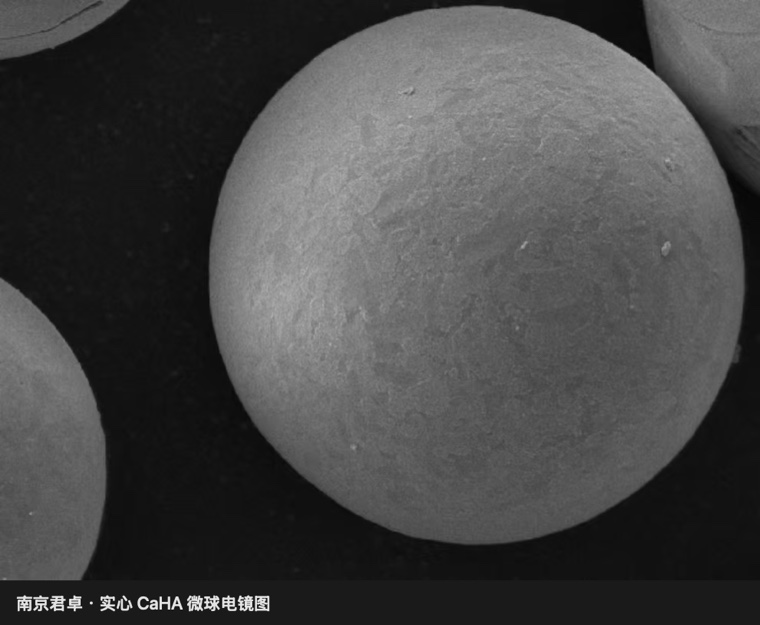
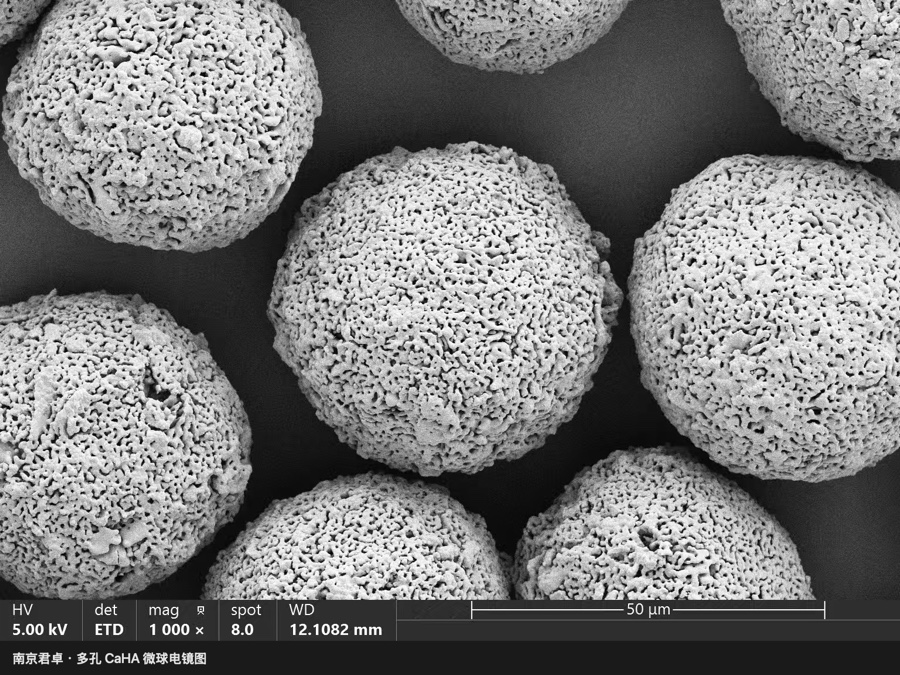
If internal structure is an acceptance attribute, the technical agreement should define a suitable method, such as cross-sectional microscopy, micro-CT, or project-specific porosity testing. The appropriate method depends on particle size, pore architecture, and intended use. Fragment, irregular-particle, and agglomerate fractions likewise require multiple fields of view and consistent classification rules.
A qualified sample still needs a lot-to-lot bridge
Development teams often screen a small sample before moving to scale-up evaluation and routine purchasing. The missing link is frequently not another test, but traceability between the evaluated sample and later supply. Sample code, manufacturing lot, test date, method version, and reported result should refer to the same material.
A practical sequence has three steps: confirm morphology and formulation compatibility with a development sample; verify the agreed tests on a representative lot; then place repeatable acceptance criteria in the purchasing specification or quality agreement. Sample images support technical discussion, but they do not replace release data for subsequent lots.
Turn the inquiry into executable acceptance criteria
An effective request for quotation should tell the supplier what must be measured and allow the buyer to review later lots on the same basis. The following items are more actionable than a general statement that “particle size complies”:
| Item | What the parties should agree |
|---|---|
| Microsphere size | Population, method, diameter definition, particle count, and out-of-range fraction |
| Surface morphology | Sphericity, surface features, sampling fields, and rules for fragments or irregular particles |
| Structure/porosity | Target solid or porous structure and a project-appropriate method for confirming the interior or pore system |
| Material composition | Application-specific XRD phase, Ca/P reporting basis, and relevant impurity requirements |
| Lot records | Lot identifier, measured values, method version, retained samples, deviation handling, and change notification |
Priorities depend on the downstream design. A suspension project may focus on dispersion, sedimentation, and delivery behavior. A porous carrier or composite may place more weight on pore architecture, surface area, or interfacial bonding. Specifications should support the intended development program rather than placing every measurable parameter on a routine COA.
TDS, COA, and SDS serve different purposes
A TDS describes technical information and typical specifications. A COA reports test results for a specific lot. Binding limits, methods, and decision rules belong in the agreed purchasing specification or quality agreement. An SDS addresses handling, transport, and emergency information; it is not a substitute for lot-quality evidence.
COA review should also distinguish a reported result from a conformance decision. A value without a corresponding limit, method identifier, or method version may not be sufficient for comparing future lots. For continuing supply, consistency of the measurement basis can be as important as the number itself.
Change control determines whether later data remain comparable
If sieving, drying, heat treatment, or test equipment changes between sample approval and routine supply, the nominal grade may remain 25–45 μm while the distribution, surface state, or measurement basis changes. Our article on CaHA particle manufacturing and change control discusses why these changes may require renewed evaluation.
As of September 2026, China's 2014 Good Manufacturing Practice for Medical Devices remains in force and requires medical-device manufacturers to control purchasing, evaluate suppliers, and inspect or verify purchased materials [4]. A revised GMP, issued as NMPA Announcement No. 107 of 2025, will take effect on November 1, 2026 and adds more detailed risk-based requirements for material and supplier management [5]. These obligations apply to downstream medical-device manufacturers; they do not automatically impose the complete finished-device GMP framework on every upstream CaHA supplier.
What Nanjing Junzhuo can provide
Nanjing Junzhuo can provide a 25–45 μm CaHA microsphere grade and solid or porous samples for development evaluation. Before routine supply, the parties should agree on the target structure, measurement basis, acceptance limits, lot documents, and change-notification requirements.
A raw-material specification defines the requirements for material identity and lot-to-lot comparability; conformity still depends on the corresponding test results and lot records. It cannot replace rheology, injectability, stability, biological, or clinical verification of a downstream formulation. Keeping these evidence levels separate makes the supplier commitment clearer and prevents a particle-size range from being treated as a complete product definition.
This article discusses CaHA microsphere purchasing and specification management. Raw-material test results are not evidence of the safety or effectiveness of a particular medical product.
References
- U.S. Food and Drug Administration. RADIESSE Injectable Implant: Instructions for Use. The device description states a 25–45 μm CaHA particle-size range for the named finished product. FDA source document.
- International Organization for Standardization. ISO 13320:2020, Particle size analysis — Laser diffraction methods. ISO standard page.
- International Organization for Standardization. ISO 13322-1:2014, Particle size analysis — Image analysis methods — Part 1: Static image analysis methods. ISO standard page.
- China Food and Drug Administration. Good Manufacturing Practice for Medical Devices, Announcement No. 64 of 2014. Government republication.
- National Medical Products Administration. Announcement on the Good Manufacturing Practice for Medical Devices, Announcement No. 107 of 2025. Effective November 1, 2026. Chinese government publication.