Discussions of CaHA-CMC for facial rejuvenation often focus on whether the product is diluted or hyperdiluted.
Ratios such as 1:1 and 1:2 are easy to remember, but they do not answer a more important question: what material state is being created, in which tissue plane, and for what purpose?
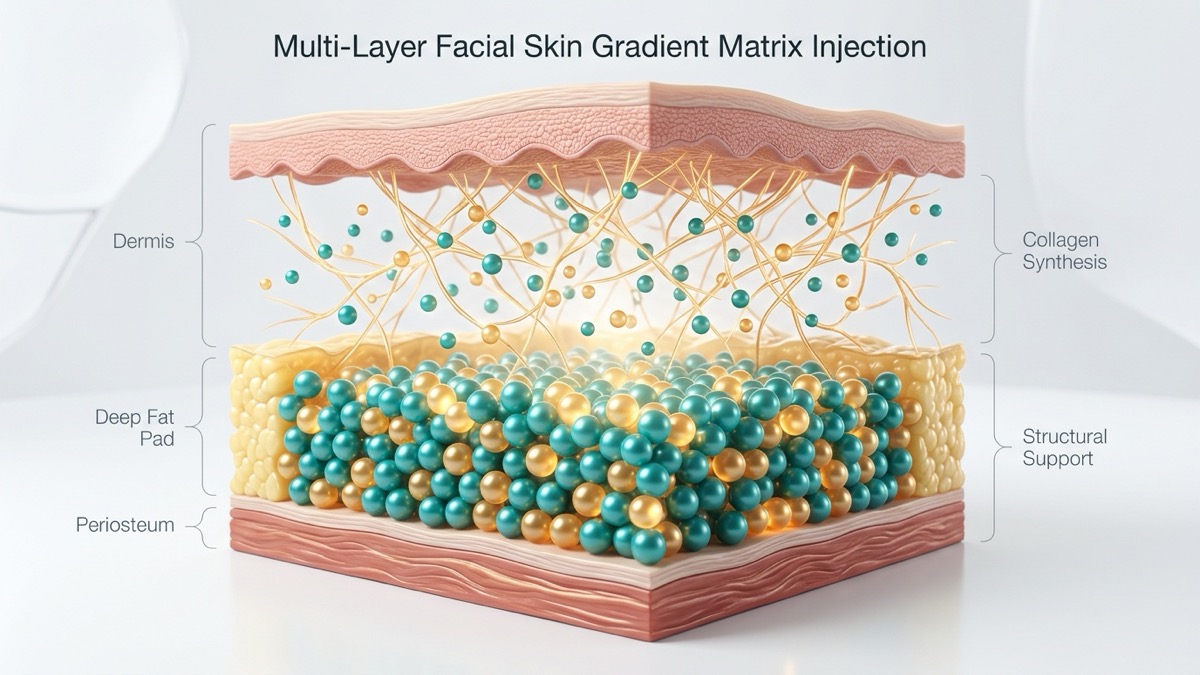
In 2026, Plastic and Aesthetic Nursing published a methods article describing a layered, gradient-based full-face approach to CaHA-CMC. The author associated more concentrated CaHA-CMC with deeper placement and structural projection, while hyperdiluted material was used more superficially with a focus on skin texture and laxity. Rheological data were incorporated to explain the rationale for this layered design.
This was not a randomized trial comparing the clinical performance of different dilution ratios. It was a methods article that combined rheological data with practical experience to propose a standardized layered protocol. The paper helps frame the relationship among concentration, tissue plane, and intended function, but it does not show that one protocol is superior to another.
Dilution Changes More Than Particle Concentration
CaHA-CMC is a dispersed system containing CaHA particles in a carboxymethylcellulose carrier. Adding diluent reduces both the particle concentration and the carrier concentration per unit volume. The 2026 article also uses rheological data to discuss changes in material state and to connect those states with different tissue planes.
Distribution in tissue can also depend on the finished-product composition, tissue plane, and conditions of use. A 1:2 ratio does not guarantee that different CaHA-CMC products will have the same material behavior.
The 2018 global consensus defined 1:1 as diluted CaHA and ratios of 1:2 or greater as hyperdiluted CaHA. Those terms are now widely used, but the publication described itself as preliminary consensus guidance and called for further clinical research. A ratio describes how a product was diluted; it does not by itself define what the material is expected to do in tissue.
Deep and Superficial Planes Serve Different Goals
The 2026 framework associates more concentrated CaHA-CMC with deeper planes and structural contouring. Hyperdiluted material is placed more superficially, where the emphasis shifts toward distribution and skin-quality goals.
| Material state proposed in the paper | Intended design goal |
|---|---|
| More concentrated CaHA-CMC | Deeper placement with an emphasis on structural projection |
| Hyperdiluted CaHA-CMC | More superficial placement with an emphasis on distribution and skin-quality assessment |
Facial tissue planes differ in composition and mechanical environment. Deeper use is discussed mainly in terms of contour and support. In more superficial planes, distribution and the subsequent tissue response become more prominent. The framework therefore starts with the intended function before selecting a material state for a particular plane.
Hyperdiluted CaHA Remains a Particle Dispersion
Hyperdiluted CaHA is sometimes described simply as a collagen-stimulating liquid. From a materials perspective, that description is incomplete.
CaHA remains particulate after dilution. Particle characteristics, carrier composition, and the quality of dispersion after dilution still influence the system. Hyperdilution describes a formulation and use state; it does not turn the particulate system into an ordinary liquid.
Visible Improvement Is Not a Measurement of Collagen
CaHA publications often discuss neocollagenesis, changes in elastic fibers, and extracellular-matrix remodeling. The 2026 methods article likewise connects superficial hyperdiluted use with neocollagenesis.
Clinical appearance and histological quantification answer different questions. A previously reviewed randomized study of CaHA-CMC diluted 1:2 for décolleté wrinkles used a wrinkle-rating scale as its primary endpoint. The Week 24 difference showed an improvement in appearance relative to an untreated control, but it could not quantify an increase in dermal collagen.
Full-face use can also change contour, reflected light, and skin tension. The final appearance may reflect both structural change and tissue remodeling, so it should not be attributed entirely to collagen formation.
What Does the Gradient Framework Establish?
The methods article places concentration, tissue plane, and intended function in one framework. Reporting only that CaHA was used, or that it was diluted 1:2, leaves out the purpose of that material state, the plane being discussed, and whether the supporting evidence comes from rheology, clinical appearance, or histology.
The article did not randomly compare a gradient protocol with a fixed-dilution protocol. It also cannot establish that the proposed relationship between concentration and tissue plane applies to every finished CaHA-CMC product. It offers a framework for further evaluation, not a universal standard.
A dilution ratio is one part of the material state and should be interpreted together with tissue plane and intended function.
This article reviews published work on CaHA-CMC material state, tissue plane, and evidentiary limits. It does not provide injection instructions, recommend a product, or offer individual treatment advice.
References
- Gladstein I. A Multilayered Gradient Approach to Calcium Hydroxylapatite for Enhanced Full-Face Contouring and Biostimulation. Plastic and Aesthetic Nursing. 2026;46(3):163–169. DOI: 10.1097/PSN.0000000000000669.
- Goldie K, Peeters W, Alghoul M, et al. Global Consensus Guidelines for the Injection of Diluted and Hyperdiluted Calcium Hydroxylapatite for Skin Tightening. Dermatologic Surgery. 2018;44(Suppl 1):S32–S41. DOI: 10.1097/DSS.0000000000001685.
- Fabi S, Moradi A, Hill D, et al. Diluted Calcium Hydroxylapatite Carboxymethylcellulose (Radiesse) for Décolleté Wrinkles: Safety and Effectiveness in Adult Females. Aesthetic Surgery Journal. Published online July 9, 2026. DOI: 10.1093/asj/sjag142.