In late March 2026, the consumer associations of Beijing, Tianjin, and Hebei issued a joint warning against using hydroxyapatite products registered for orthopedic or dental indications in facial aesthetic injections. The warning described this practice as use beyond the approved scope of those devices[1][2].
This does not mean CaHA lacks a compliant route in regenerative aesthetics. Since 2025, public review documents have shown facial-filler products based on calcium phosphate microspheres entering review and approval pathways in China[5][6]. The regulatory issue is narrower and more practical: products whose registered scope does not include facial injection cannot be repackaged, ground, mixed, or marketed as aesthetic injectable materials.
For upstream material teams, the warning brings the discussion back to a practical material question: why are CaHA microspheres designed for injectable systems not interchangeable with irregular orthopedic or dental particles?
Why Cross-Category Use Happens
Many hydroxyapatite products already on the Chinese market are registered for non-load-bearing bone-defect filling, alveolar-bone defect filling, or related orthopedic and dental uses[1]. Their design logic is built around hard-tissue repair: mineral support, pore structure, mechanical interlocking, and bone-contact behavior.
Cross-category use tends to emerge when market demand for regenerative aesthetics is combined with loose interpretation of device registration language. Terms such as "Class III device" or "hydroxyapatite" can be used in marketing as if they automatically authorize facial injection. Industry investigations in 2025 had already pointed to disputes around off-label or non-compliant use of such products in aesthetic settings[3][4]. From a materials perspective, this is not merely a legal distinction. It places particles designed for hard-tissue environments into a very different soft-tissue setting.
Finished Injectable Systems Are Different From Orthopedic Particles
A compliant CaHA-based regenerative aesthetic injectable is a complete product system. It typically combines micron-scale CaHA particles with a defined carrier, controlled dispersion, prefilled packaging, sterilization, and finished-product testing. Public Chinese review documents for facial filler products include technical requirements around calcium phosphate content, average particle size, particle-size distribution, phase composition and crystallinity, extrusion force, sterility, and bacterial endotoxin[5][6].
Orthopedic and dental hydroxyapatite products are commonly supplied as irregular granules, powders, or porous ceramic blocks. Their purpose is to interact with bone defects, not to distribute predictably in facial soft tissue. Grinding these products into powder does not automatically control particle-size upper limits, sphericity, surface sharpness, pore architecture, sterility, or final injectable performance.
How Morphology Shapes Downstream Soft-Tissue Verification
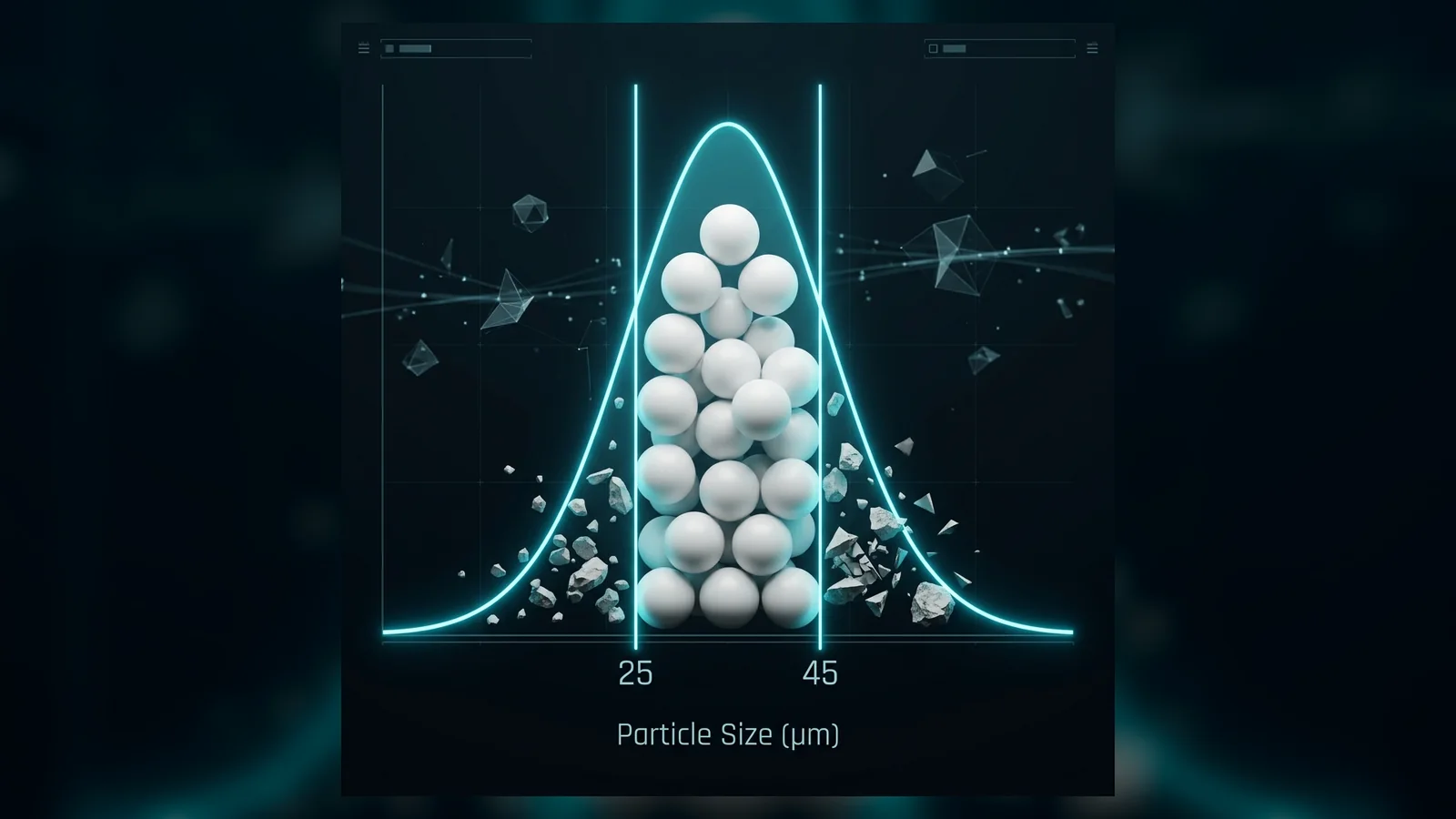
Particle morphology can influence tissue-response patterns in soft tissue. Narrowly distributed, spherical, and smooth CaHA microspheres are easier to evaluate as a dispersed particulate phase in a carrier system. This supports downstream verification around extrusion behavior, tissue distribution, and long-term response. Irregular particles, wide particle-size distributions, or sharp fragments can introduce additional uncertainty around local aggregation, mechanical irritation, and macrophage response.
Published discussions of CaHA-CMC systems focus on the interaction among the particulate phase, carrier, macrophages, fibroblasts, and local tissue environment[7][8]. These studies help explain why particle uniformity and morphology matter, but they should not be read as clinical-performance claims for any single upstream raw material. For a raw-material supplier, the more appropriate framework is particle-size distribution, sphericity, surface condition, phase purity, endotoxin control, and batch consistency.
The Beijing-Tianjin-Hebei warning listed possible adverse outcomes after non-compliant injection, including hard nodules, granuloma, persistent swelling, pain, and difficult repair[1][2]. Those clinical risks belong to the regulatory notice and the use scenario, not to an upstream raw-material claim. Still, they underline why morphology control and product-format compliance should be evaluated together.
Why On-Site Powder Mixing Is a Process Risk
The second major risk is process control. Products misused across categories are often supplied as powder or granules, and some institutions reportedly mix them manually in treatment rooms or procedure areas[1][2].
A finished injectable product must be manufactured under controlled conditions, with defined mixing, filling, sterilization, batch release testing, endotoxin control, and documentation. Manual on-site mixing cannot provide the same assurance of sterile processing or finished-product inspection. The resulting risks are not solved by choosing a different raw material; they reflect the absence of a controlled injectable-product system.
What to Check in Upstream CaHA Microsphere Evaluation
For CaHA microsphere raw materials intended for downstream regenerative aesthetic formulation development, evaluation should focus on verifiable material parameters rather than broad aesthetic claims.
- Particle-size distribution: D10, D50, D90, and span should be defined and monitored across lots.
- Microsphere morphology and sphericity: SEM review should assess roundness, fragments, aggregation, and surface sharpness.
- Phase purity and crystallinity: XRD and related methods help confirm phase composition and reduce uncertainty from unwanted phases.
- Endotoxin and microbiological control: These are upstream safety-related prerequisites for downstream injectable-system development.
- Batch consistency: Stable morphology, chemistry, and particle-size distribution support formulation screening, scale-up, and regulatory documentation.
These parameters do not automatically translate into superior clinical outcomes. They do, however, form the material basis that downstream teams need for product verification and compliance planning.
Compliance Lessons for Regenerative Aesthetic Materials
First, indication scope and material form must match. Orthopedic or dental hydroxyapatite products whose registered scope does not include facial injection cannot become compliant aesthetic injectables through grinding, dilution, or repackaging.
Second, the compliant pathway returns to a complete injectable system. CaHA particles, carrier design, dispersion, filling, sterilization, testing, labeling, and traceability must be designed as one system.
Third, upstream suppliers should focus on stable materials and documentation support. Nanjing Junzhuo supports downstream R&D teams with CaHA, HAp, β-TCP, and related calcium-phosphate bioceramic materials, focusing on particle-size distribution, microsphere morphology, phase purity, batch consistency, endotoxin control, and documentation support for regenerative aesthetic formulation development, bone repair, coatings, and research translation.
The regulatory warning is not the end of the category discussion. From the material side, it is a useful recalibration: an injectable product is not a marketing phrase. It is a material system that must be engineered, tested by batch, and traced through a compliant product pathway.
References
- China News Service. Beijing-Tianjin-Hebei consumer associations warn against non-compliant cross-use of hydroxyapatite in aesthetic injections. 2026-03-31.
- Beijing Municipal Administration for Market Regulation / Beijing News Radio. Warning against cross-use of hydroxyapatite in medical aesthetics. 2026-04-02.
- 21st Century Business Herald. Hydroxyapatite market heat and compliance disputes. 2025-01-10.
- China Consumer News / Xinhua. Cross-category medical aesthetics and compliant use of hydroxyapatite products. 2025-02-26.
- Center for Medical Device Evaluation, NMPA. Technical review report for injectable calcium phosphate microsphere facial filler, acceptance no. CQZ2301419.
- Center for Medical Device Evaluation, NMPA. Technical review report for RADIESSE INJECTABLE IMPLANT, acceptance no. JQZ2300318.
- Aguilera SB, McCarthy A, Khalifian S, et al. The Role of Calcium Hydroxylapatite (Radiesse) as a Regenerative Aesthetic Treatment: A Narrative Review. Aesthetic Surgery Journal. 2023;43(10):1063–1090. DOI: 10.1093/asj/sjad173. PMID: 37635437. PMCID: PMC11025388.
- Nowag B, Schäfer D, Hengl T, Corduff N, Goldie K. Biostimulating fillers and induction of inflammatory pathways: A preclinical investigation of macrophage response to calcium hydroxylapatite and poly-L-lactic acid. Journal of Cosmetic Dermatology. 2024;23(1):99–106. DOI: 10.1111/jocd.15928. PMID: 37593832.