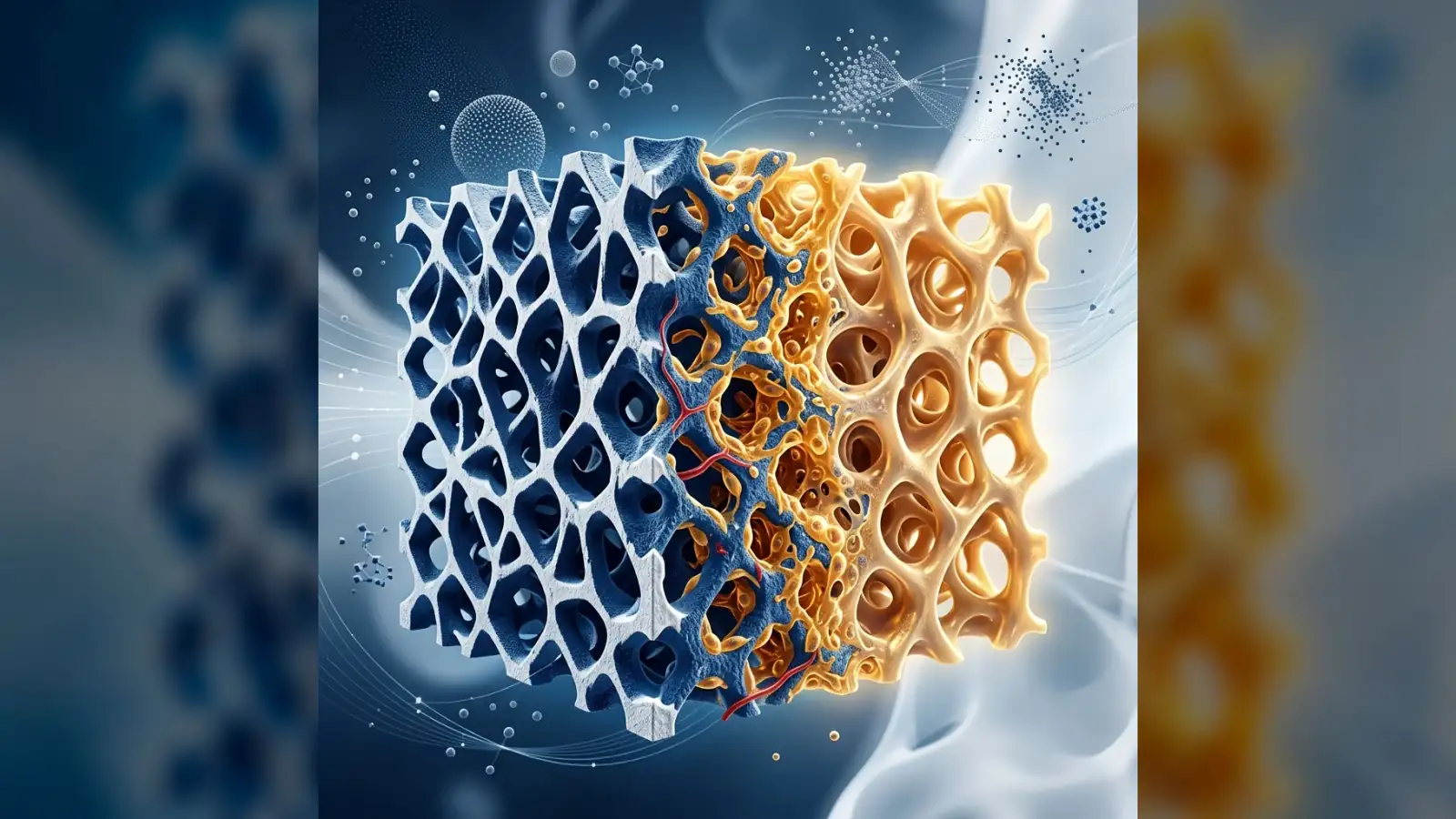
For bone repair materials, filling a defect is only the starting point. As the material is gradually resorbed in the host environment, it still needs to provide a stable window of support for new bone ingrowth. Beta-tricalcium phosphate (β-TCP) is one of the most widely used resorbable calcium-phosphate bioceramics, and its evaluation has shifted from "will it be resorbed?" to "does its resorption pace align with new bone formation?"
That pace is shaped before the finished system ever reaches application testing. At the upstream material level, sintering temperature, density, surface area, phase purity, and particle grading all affect β-TCP dissolution, cell-mediated resorption, and interfacial remodeling. For downstream R&D teams seeking more predictable scaffold behavior, these variables usually need to be tightly controlled at the powder stage.
Why Resorption and Bone Formation Need to Stay in Step
In cranial defects, spinal fusion, and long-bone defects, bone formation rate varies with anatomical site, patient age, defect size, and local vascular supply. If β-TCP resorbs too quickly, the material may diminish before new bone ingrowth has progressed sufficiently, shortening the support window in the defect region. If it resorbs too slowly, residual material can persist alongside new bone, occupying remodeling space and slowing trabecular continuity recovery. Ion release during degradation also modulates the local ionic microenvironment; its influence on osteogenic cell responses depends on release rate, concentration window, and the specific material system.
Animal studies and review literature suggest that the in vivo behavior of β-TCP scaffolds depends closely on when degradation occurs and how far it progresses, not simply on whether the material eventually disappears. Similar patterns appear in clinical follow-up literature: β-TCP products with different sintering processes or particle sizes can show different resorption and new-bone outcomes at comparable anatomical sites, beyond what the shared "β-TCP" label can explain.
Upstream Variables That Shape β-TCP Degradation
β-TCP degradation involves three parallel processes: dissolution, cell-mediated resorption (osteoclast activity), and interfacial remodeling. Several powder-level process parameters act on all three at once.
Sintering temperature directly governs crystallinity and density. When sintering is too low, insufficient density can elevate the initial dissolution rate. When sintering is too high, or when post-sintering cooling rate is poorly controlled, such as overly rapid cooling, a phase transition from β-TCP to α-TCP may occur and leave residual high-temperature phase. Residual α-TCP has higher solubility and can accelerate or destabilize the overall degradation rate.
Residual α-TCP is easy to overlook in the powder itself, but it can have a clear effect on degradation behavior. Routine X-ray diffraction (XRD) can resolve phase composition, but lot-to-lot α-TCP variation often maps onto early-phase resorption variability after implantation. A parallel process variable is the Ca/P ratio. Deviations in Ca/P ratio shift the solubility product; even when phase composition appears acceptable, weak stoichiometric control can push solubility outside the expected range.
Surface area defines the active interface between the material and surrounding body fluids and cells; finer particles and higher porosity generally accelerate initial degradation. Trace-element doping (Mg, Sr, etc.) is used in some material synthesis and characterization studies as an engineering lever to fine-tune degradation rate, but industrial scale-up adds an additional requirement: doping homogeneity.
Particle Grading and Geometry: From Powder to Granule to Scaffold
β-TCP is used in several downstream formats: granular bone-void fillers, injectable mineralized pastes, bulk sintered ceramics, and 3D-printed porous scaffolds. Degradation pace is not uniform across these formats. Narrow-grading granular fillers usually resorb more predictably than wide-grading powders. Porous scaffolds are strongly affected by pore size distribution and pore interconnectivity.
For an upstream supplier, this means a single β-TCP lot is rarely suited to every format. Granular filling and 3D bioink printing place different demands on flowability, particle size distribution, surface condition, and sintering shrinkage. Bringing this distinction forward into raw-material screening is an efficient way to avoid later process iteration.
BCP as a Pacing Strategy
HAp is resorbed very slowly in vivo, while β-TCP, in suitable morphology, can be meaningfully resorbed within a moderate time window. Combining the two at engineered ratios — biphasic calcium phosphate (BCP) — is a common pacing strategy in the literature.
Different ratios serve different applications. HAp-rich BCP (such as 80/20 or 70/30) leans toward long-term support and is often discussed for scenarios that need sustained osseointegration. β-TCP-rich BCP (such as 40/60 or 20/80) emphasizes earlier resorption and faster remodeling. BCP is not simply a physical mixture. How HAp and β-TCP are distributed within the same particle, through co-sintering, surface modification, or composite microsphere design, can reshape the actual degradation curve. In some BCP systems, preferential β-TCP dissolution may also modify local pore structure, leaving a relatively stable HAp-rich framework to continue supporting the interface. This is why different BCP raw materials with the same nominal name can behave differently, and why multi-lot verification matters for downstream teams.
What Downstream Teams Should Evaluate in β-TCP Raw Materials
First, review multi-lot XRD and phase purity. A single clean batch does not establish process stability. Residual α-TCP levels must remain within a consistent and tightly controlled window across multiple lots.
Second, examine sintering process consistency. Sintering temperature, dwell time, ramp curve, and cooling profile all influence final crystallinity and density. Whether the supplier can provide process records and in-process data is an important indicator of stability.
Third, look at particle grading and surface area. Different application formats demand different grading windows. A supplier's ability to tailor the grading window to specific downstream targets directly determines formulation-screening flexibility.
Fourth, assess impurities and documentation support. Achieving stable control of trace metals, radionuclides, endotoxin, and microbiological limits is often the rate-limiting step during registration preparation, surfacing earlier than single-performance metrics.
Fifth, consider whether the supplier can support BCP and custom development. When a project requires adjustment of the HAp/β-TCP ratio, particle morphology, or pore structure for a specific application, suppliers with custom development capability can engage earlier in design planning.
Nanjing Junzhuo's Material Support Direction
At the β-TCP raw-material level, Nanjing Junzhuo supports downstream R&D teams by focusing on sintering process consistency, phase purity (α-TCP residual control), particle grading, surface area, impurity control, and documentation support. The same upstream support extends to HAp, BCP, and other calcium-phosphate bioceramic materials, covering formulation screening, product verification, and custom development for bone repair, spinal fusion, composite scaffolds, 3D-printing bioinks, and research translation — including coordinated adjustment of HAp/β-TCP ratios and sintering parameters across different application formats.
Conclusion
Bone repair material evaluation should re-center on the match between degradation pace and bone formation rate. This alignment is reflected at the application level as the synchronization between resorption and osteogenesis curves, and on the material side as a set of controllable, reviewable, batch-stable process parameters. For teams aiming to bring a scaffold into systematic verification, the real competitive ground for β-TCP is not the label itself, but whether each lot of powder can reproduce the same degradation pace.
References
- Bohner M, Santoni BLG, Döbelin N. β-tricalcium phosphate for bone substitution: Synthesis and properties. Acta Biomaterialia. 2020;113:23–41. DOI: 10.1016/j.actbio.2020.06.022. PMID: 32565369.
- Sheikh Z, Abdallah MN, Hanafi AA, et al. Mechanisms of in vivo degradation and resorption of calcium phosphate based biomaterials. Materials. 2015;8(11):7913–7925. DOI: 10.3390/ma8115430. PMID: 28793687. PMCID: PMC5458904.
- Lobo SE, Arinzeh TL. Biphasic calcium phosphate ceramics for bone regeneration and tissue engineering applications. Materials. 2010;3(2):815–826. DOI: 10.3390/ma3020815. PMCID: PMC5513510.
- Wang Z, Guo Z, Bai H, Li J, Li X, Chen G, et al. Clinical evaluation of β-TCP in the treatment of lacunar bone defects: A prospective, randomized controlled study. Materials Science and Engineering: C. 2013;33(4):1894–1899. DOI: 10.1016/j.msec.2012.12.041.
- Walsh WR, Vizesi F, Michael D, Auld J, Langdown A, Oliver R, et al. β-TCP bone graft substitutes in a bilateral rabbit tibial defect model. Biomaterials. 2008;29(3):266–271. DOI: 10.1016/j.biomaterials.2007.09.035. PMID: 18029011.
- Chan SSL, Heath DE, Franks GV. 3D printing of multi-scale porous β-tricalcium phosphate scaffolds: Mechanical properties and degradation. Open Ceramics. 2024;19:100630. DOI: 10.1016/j.oceram.2024.100630.
- Qi D, Su J, Li S, Zhu H, Cheng L, Hua S, et al. 3D printed magnesium-doped β-TCP gyroid scaffold with osteogenesis, angiogenesis, immunomodulation properties and bone regeneration capability in vivo. Biomaterials Advances. 2022;136:212759. DOI: 10.1016/j.bioadv.2022.212759. PMID: 35929304.