Hydroxyapatite (HAp) should be evaluated for its intended use. Bone-repair and dental-material research commonly examines calcium-phosphate composition, particle structure, and biological responses. For heterogeneous catalyst supports, evaluation also needs to cover metal dispersion, reactant adsorption, and interfacial changes during reaction. These questions determine which material properties need to be measured.
On October 9, 2026, researchers from the University of Science and Technology of China and the SINOPEC Research Institute of Petroleum Processing published a study in the Journal of the American Chemical Society (JACS). They constructed spatially differentiated RhFe single-atom alloy and nanoalloy sites on hydroxyapatite (HAp). Their interpretation connects cooperation between these sites with reconstruction of the Fe–HAp interface, providing evidence for how the support participates in hydroformylation. [1]
How two types of RhFe sites share reaction tasks
In hydroformylation, an alkene reacts with carbon monoxide and hydrogen to form an aldehyde with one more carbon atom than the starting alkene. A heterogeneous rhodium catalyst must retain its active components while coordinating the adsorption and activation of different reactants. The paper addresses both Rh leaching and the suppression of hydrogen activation by CO.
CO is required for the steps that produce the aldehyde, but its occupation of metal sites can also restrict hydrogen dissociation. Catalyst design must therefore consider both CO utilization and the supply of activated hydrogen. Stronger adsorption of one reactant alone does not fully explain catalytic efficiency.
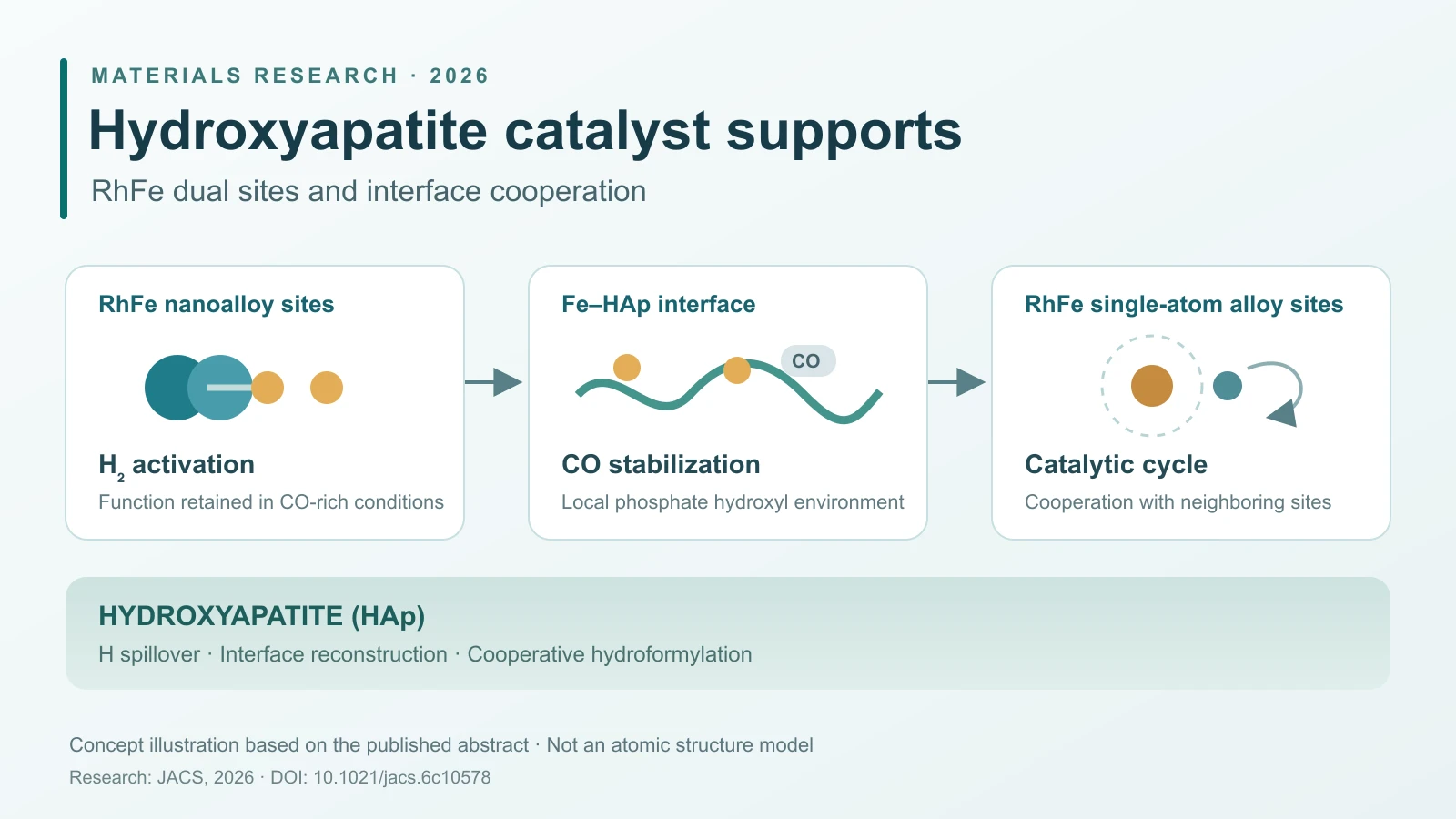
The researchers combined neighboring RhFe single-atom alloy (SAA) and nanoalloy (NA) sites. According to their mechanistic interpretation, the nanoalloy sites facilitate H₂ dissociation even under CO-rich conditions, while adjacent single-atom alloy sites mediate the catalytic cycle. The sites perform complementary tasks in hydrogen activation and the catalytic cycle, helping to reduce the constraints imposed by competitive adsorption. [1]
Total Rh and Fe content alone does not describe the active structure of this catalyst. Assessing whether the reported cooperative structure has formed requires information about local metal coordination, the spatial relationship between sites, and their contact with the support. Matching the nominal metal ratio is insufficient to establish an equivalent active structure.
How hydrogen spillover connects metal sites with the HAp interface
The authors used mechanistic and operando studies to connect hydrogen dissociation on the RhFe nanoalloy with subsequent interfacial changes. After H₂ dissociates, activated hydrogen species migrate toward neighboring regions through hydrogen spillover.
The public abstract reports that hydrogen spillover reconstructs the defect-rich Fe–HAp interface, creating what the authors describe as a phosphate hydroxyl microenvironment. This environment stabilizes interfacial CO, creating a local CO reservoir for carbonyl insertion in the catalytic cycle at neighboring single-atom alloy sites. Here, “reservoir” refers to local stabilization and supply at the reaction interface. [1]
The HAp interface described here forms under specific preparation and reaction conditions. Its ideal formula, Ca₁₀(PO₄)₆(OH)₂, describes the basic composition but does not define the entire surface after metal loading or during reaction. Support characterization should therefore cover the starting powder, the metal-loaded material, and samples under reaction conditions.
In this system, hydrogen activation on the nanoalloy, hydrogen migration, and interfacial CO stabilization are connected processes. Studying the HAp support therefore requires more than measuring metal loading: it also requires examining the spatial relationships between sites and the interfacial species formed under reaction conditions.
Two sets of performance results require separate interpretation
The public abstract separately reports tests involving styrenic substrates, C₆–C₁₀ α-olefins, and propene. The table places each substrate group alongside its temperature and reported performance to distinguish the different tests.
| Test substrates and temperatures stated in the abstract | Authors' reported result | Information to check when interpreting the result |
|---|---|---|
| Styrenic substrates and C₆–C₁₀ α-olefins, 60 °C | Conversion and selectivity both above 99% | Individual substrates, reaction time, pressure, and the definition of selectivity |
| Propene hydroformylation, 110 °C | TOF of 30,225.9 h⁻¹ | Site-counting method, rate calculation, and test conditions |
| Catalyst stability | Strong resistance to metal leaching reported | Analytical method, detection limit, and operating or recycling conditions |
Source: ACS public abstract. The temperatures above are those stated in the abstract, rather than a complete set of experimental conditions.
Turnover frequency (TOF) describes a reaction rate normalized to a defined number of catalytic sites. Comparing TOFs between studies first requires checking how the denominator was established and the conditions under which the rate was measured. TOF alone cannot be converted directly into plant capacity, product output per unit mass of catalyst, or production cost.
The abstract does not specify how the reported selectivity above 99% was defined or calculated. The wording is therefore retained without recasting it as linear-aldehyde selectivity or a particular linear-to-branched ratio. Resistance to leaching also needs to be interpreted with the relevant analytical and stability tests. No recycling count, continuous operating duration, or amount of metal leached is inferred here.
How HAp catalyst supports should be evaluated
During development of HAp catalyst supports, researchers can compare the starting powder, the metal-loaded material, and samples under reaction conditions. Comparing characterization at each stage with catalytic test results helps determine whether a compositional or surface feature affects the active structure and whether that feature changes during preparation and use.
Establish phase composition and chemistry first. XRD, FTIR, and elemental analysis provide information about crystalline phases, chemical groups, and composition, respectively. When evaluating Ca/P ratios and HAp phases, check both composition and crystalline phases; a single compositional ratio cannot replace phase identification. Tests should also establish whether metal loading and subsequent treatment change these features and whether those changes affect catalysis.
Evaluate surfaces and microstructure for the intended application. Particle size distribution, morphology, specific surface area, pore structure, and surface chemistry describe different length scales and properties. Powders with similar bulk composition still need targeted comparison of metal dispersion and interfaces after loading. Existing work on HAp surface and interface evaluation also distinguishes bulk composition from surface behavior in a particular environment; conclusions from different application environments require separate validation.
Track changes through preparation and use. Tests on the starting powder cannot replace characterization after metal loading or under reaction conditions. For each raw-material batch, development records should include the loading process, heat-treatment conditions, and post-reaction state. These records can help determine whether differences in composition, morphology, or surface properties affect catalysis and which batch variations need closer control.
Specific surface area, defects, and crystallinity should be compared with metal dispersion, interfacial species, and catalytic results for the same set of samples. Once differences that affect the reaction have been identified, they can inform raw-material specifications and batch-control criteria.
What remains to be evaluated for industrial use
Further engineering studies need to test whether the reported performance can be maintained with the intended feed and operating mode. Tracking metal structure, interfacial state, conversion, and selectivity during operation can help determine whether performance changes are related to changes in active sites or process conditions.
Catalyst shaping, heat and mass transfer, feed impurities, regeneration, and precious-metal recovery are specific topics for subsequent process evaluation. Further scale-up work can use preparation, performance, and stability data from the full paper and Supporting Information to establish a baseline and identify additional experiments. Material and process costs can then be assessed using the amount of metal required, catalyst lifetime, and recovery methods.
Evaluate HAp in relation to its working environment
Earlier studies have investigated HAp-supported metal catalysts. A 2021 paper reported atomically dispersed Rh on HAp for tandem hydroaminomethylation of olefins. Its reaction objective and active structure differ from those of the JACS study, but it provides an earlier reference for research on HAp catalyst supports. [2]
The specific contribution of the JACS study is to connect spatially differentiated RhFe sites, hydrogen spillover, and Fe–HAp interface reconstruction. For HAp development, it provides a basis for investigating relationships between composition, particle structure, surface state, and the working interface, and for testing material-design choices against corresponding catalytic data.
The same characterization method may require different interpretation when used for biomaterials and catalyst supports. For HAp powders intended for catalysis, raw-material specifications should identify which features need to be controlled and which tests are needed after metal loading, using results obtained under the intended reaction conditions.
References
- Zhang, T.; Li, J.; Wang, H.; et al. Synergistic RhFe Single-Atom Alloy and Nanoalloy Sites for Highly Efficient and Robust Heterogeneous Hydroformylation. Journal of the American Chemical Society. Published online October 9, 2026. DOI: 10.1021/jacs.6c10578.
- Li, X.; Li, L.; Qin, T.; et al. Atomically dispersed Rh on hydroxyapatite as an effective catalyst for tandem hydroaminomethylation of olefins. Molecular Catalysis. 2021;509:111671. DOI: 10.1016/j.mcat.2021.111671.
Source scope: This article interprets the public abstracts and publication information of the papers above. The full JACS paper and its Supporting Information were not obtained or reviewed. Performance and mechanism descriptions are limited to the authors' reports; the sections on material evaluation and engineering validation are analysis based on that information.
Nanjing Junzhuo