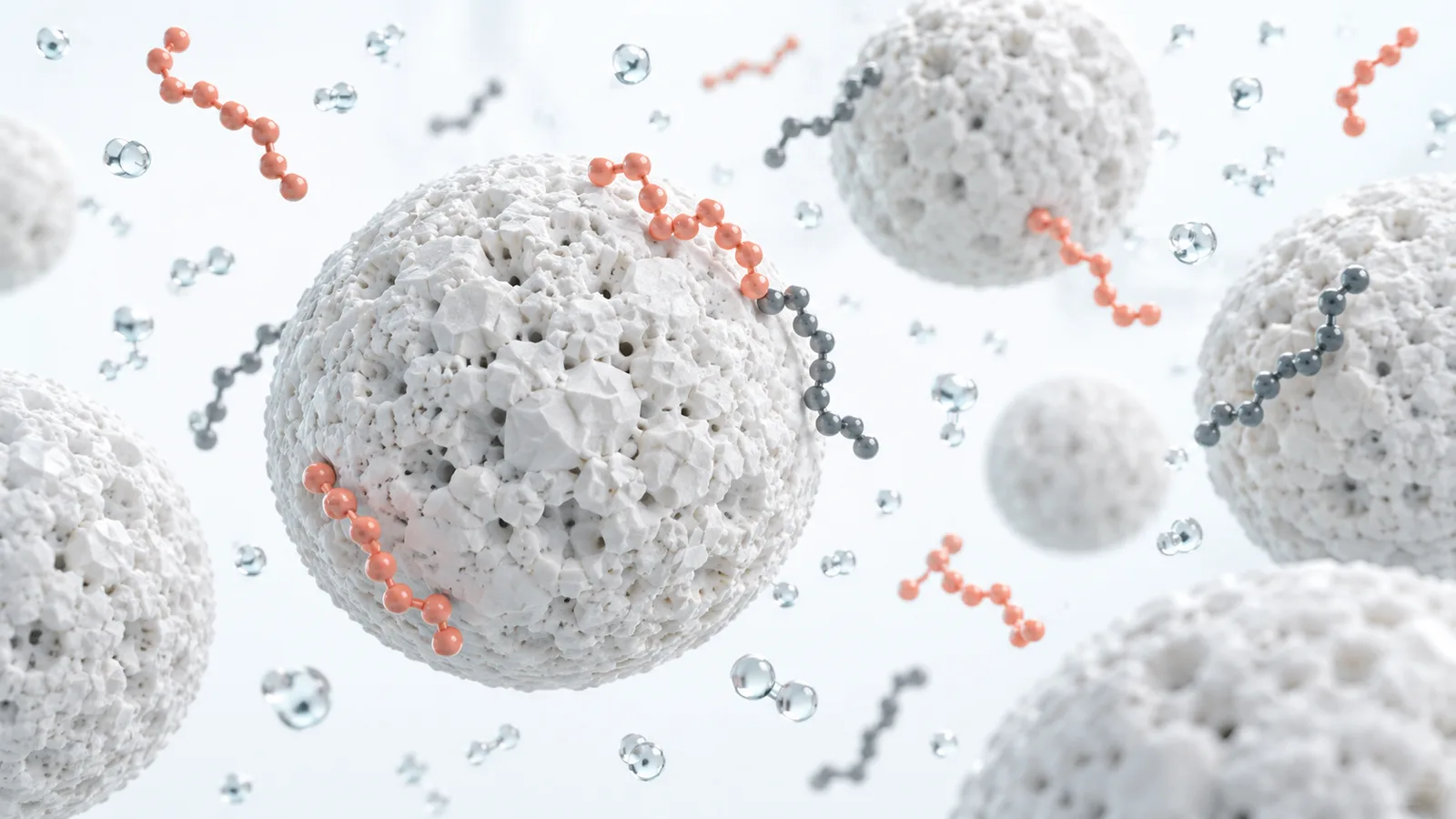
Before a functional peptide can be used with hydroxyapatite (HAp), two separate questions need answers: does it remain on the mineral surface, and does it still work once it is there?
A September 2026 study in Scientific Reports joined the human antimicrobial peptide LL-37 to an HAp-binding tag, producing a soluble recombinant fusion peptide called LL-37-HApBT. The authors measured its adsorption to a specific HAp product, then tested the fusion peptide itself in cell, hemolysis, scratch-closure, and antibacterial assays [1]. The journal currently hosts an early version of the accepted, peer-reviewed article. It is citable and carries a permanent DOI; copyediting and layout may still change before the final Version of Record.
What the fusion construct contains
The construct retains the LL-37 core. Its C terminus carries a flexible G₄S linker, the 12-residue HAp-binding tag SVSVGMKPSPRP, and a 6×His purification tag. It was recovered as a soluble recombinant peptide from E. coli, with a purified yield of 2.75 mg per liter of culture [1]. The study did not compare alternative expression systems or assess process scale-up, so this yield cannot establish a manufacturing advantage.
Earlier mineral-interface studies provide a rationale for using a binding motif: peptide sequence and charge affect interactions with HAp [2,3]. Yet the new molecule contains LL-37, a linker, and a His tag as well as HApBT. Adsorption of the whole molecule cannot be assigned to the binding motif alone.
What the adsorption number means
The authors used a commercial HAp product and measured adsorption in buffer. Uptake rose with peptide loading and approached a plateau. A segmental model estimated an apparent capacity of 54.37 µg per mg HAp (95% confidence interval, 52.17–56.57 µg per mg). After five minutes, the measured amount was 50.76 ± 0.41 µg per mg [1].
These are results for a defined mineral, medium, and loading range, not a universal loading specification for HAp powders or coatings. The study did not run native LL-37, a tag-free construct, or a charge-matched control alongside LL-37-HApBT, nor did it systematically compare other minerals. It therefore does not isolate the contribution of HApBT or establish mineral selectivity for this construct.
Free-peptide activity is not loaded-material activity
Under the tested conditions, the free fusion peptide was cytocompatible with fibroblasts and endothelial cells. Hemolysis was 1.3% at 30 µM. Scratch closure increased, while antibacterial activity was partial rather than complete [1]. A scratch assay by itself cannot separate migration from proliferation.
Those assays tested the peptide, not HAp carrying the peptide. Adsorption may alter which parts of the molecule remain exposed and the concentration available to cells or bacteria. The paper did not measure retention, desorption, or release after loading, and it did not repeat the biological assays with peptide-bound HAp. The adsorption and bioactivity findings cannot yet be combined into a claim that the mineral material itself has repair or antibacterial function.
What a complete material test would add
For composite-material development, adsorption capacity is only the first measurement. HAp particle size, porosity, and surface chemistry can change the area and sites available to a peptide. Protein- and salt-containing media may also change loading and release relative to a simple buffer. Our earlier discussion of the HAp-liquid interface addressed the same need to define the mineral and medium rather than treating HAp as an invariant surface.
A more decisive follow-up would compare this construct with tag-free and charge-matched controls on the same mineral, then measure peptide retention, release, and activity after loading. Only then could researchers distinguish a peptide that readily adsorbs from a tag that gives HAp a durable biological function. The present study establishes the first part of that route, not the second.
This is a review of published material and in vitro evidence. It does not establish the performance of Junzhuo HAp raw materials, a finished medical device, or any clinical use.
References
- Gashtasbi F, Hasannia S, Nikkhah M, et al. A soluble recombinant hydroxyapatite-binding LL-37 fusion peptide shows efficient mineral adsorption and repair-associated bioactivity. Scientific Reports. Published online September 17, 2026. DOI: 10.1038/s41598-026-72036-6.
- Duanis-Assaf T, Hu T, Lavie M, et al. Understanding the Adhesion Mechanism of Hydroxyapatite-Binding Peptide. Langmuir. 2022;38(3):968–978. DOI: 10.1021/acs.langmuir.1c02293.
- Ling C, Zhao W, Wang Z, et al. Structure-Activity Relationships of Hydroxyapatite-Binding Peptides. Langmuir. 2020;36(10):2729–2739. DOI: 10.1021/acs.langmuir.9b03779.